
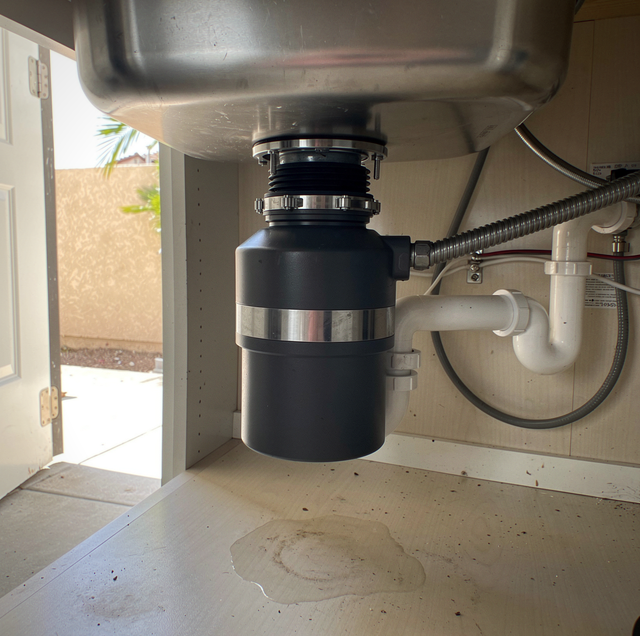
A garbage disposal is held up by one thing and nothing else. It has no legs, no bracket screwed into the cabinet floor, and nothing touching the wall behind it. The full weight of the motor and grind chamber hangs from the mounting assembly clamped around the sink's drain opening, and that assembly is not a single part but a stack of separate ones, each doing a different job.
Quick Answer: A rocking or rattling disposal almost always means the mounting stack under the sink, the ring, screws, or snap ring that clamp the unit to the flange, has lost its grip. The unit itself is usually fine.
Every symptom of a loose mount reports that same thing. A body hanging lower than it used to, or sitting out of square against the underside of the sink. A basin that buzzes while the unit runs. A low resonance carrying through the cabinet. None of it points at the motor. It points at one layer of the stack that has stopped holding, leaving the unit to swing on rings and screws that no longer clamp. A rattle that began right after something hard went down the drain is a different fault caused by damage inside the grind chamber.
That stack is built in layers, and what each layer does is the fastest way to see why a disposal starts moving in the first place.
Everything in the Stack Hangs from the Sink Flange
The flange is the metal collar you can see and touch from inside the sink bowl, the ring around the drain opening. It looks decorative, but its real job is structural: everything else in the mounting assembly hangs from this one piece. The flange's lower half extends down through the drain opening and threads into the rest of the stack, so any looseness that develops below it eventually shows up as movement at the flange itself, even though the flange rarely fails on its own.
Under the Deck, a Gasket and a Backup Ring Spread the Load
Directly beneath the sink deck, a fiber gasket sits against the underside of the metal around the flange, followed by a backup ring, often a flat metal plate, positioned just below that. The backup ring's job is to distribute clamping pressure evenly around the flange's full circumference rather than letting it concentrate at one or two points. Without it, tightening the mount would flex the thin sink metal locally rather than compress the gasket evenly, and the seal would never fully seat, no matter how hard the hardware above it was torqued.
Three Screws, Evenly Tensioned, Are What Clamp the Stack
The mounting ring wraps around the backup ring and gasket, drawing the whole stack tight against the underside of the sink with three screws spaced evenly around its circumference. Three points of contact hold the assembly square as long as all three carry roughly even tension. The moment one screw backs off even a turn or two, the other two end up carrying uneven load, and the ring starts to rock on the two that are still snug instead of sitting flat against the sink deck.
Why the Snap Ring Is Not What Holds the Weight
A snap ring seats into a groove machined around the flange body and keeps the assembly from separating once it's in place. It does not carry the clamping force the way the screws do; it holds the ring, gasket, and backup ring from sliding apart once they are compressed together. If the snap ring never fully seats in its groove during installation, or works partway out later, the layers beneath it lose the one thing keeping them stacked as a unit.
How the Body Locks onto the Mounting Ring
The disposal's upper housing has mounting lugs machined into its rim, and they are a different part from the impeller lugs that grind down inside the chamber. Twisting the unit into the ring raises the mounting lugs up and under the matching tabs until they lock together, which is how the full weight of the motor and grind chamber is supported by the ring rather than by anything touching the cabinet floor or walls. If the mounting ring below those lugs isn't seated tightly against the sink, the disposal has already lost some of its support before it's even turned on.
A disposal that has fully separated from its mount can drop without warning under its own weight. Keep hands and head clear of the cabinet opening below it, and leave loosening or resetting the mount to a plumber.
What a Loose Mount Does to Everything Downstream
A loosened mount rarely stays a single, isolated problem. Once the clamping pressure that holds the gasket compressed starts to drop, water can begin working past the flange seal, which is usually where a flange leak starts; why a disposal leaks and why the mount loosened in the first place are related but separate questions worth tracking down on their own. At the same time, as the body shifts even slightly, the discharge tube connecting to the trap gets pulled out of its original alignment, putting steady strain on the slip nuts and gasket at that joint instead of the straight, unstressed run it was installed with. And the vibration itself gets worse: a loose mount transmits more of the motor's vibration into the sink and cabinet than a tight one absorbs, which is exactly what keeps the remaining screws working loose. The problem accelerates instead of holding steady.
Three Ways a Mount Works Itself Loose
Mounting screws back off under ordinary running vibration, a fraction of a turn at a time, especially once uneven tension has begun between the three screws. Plumber's putty under the flange behaves differently: it stays pliable when freshly applied but hardens and shrinks with age and repeated heat cycling from hot dishwater. Once it has shrunk, it no longer fills the gap it was originally compressed into, leaving the stack above it with less to grip. And in hard-water areas, the thin sheet metal around the drain opening can pit and corrode over years of exposure, so a mounting ring that used to seat against smooth, sound metal ends up seated against an uneven, weakened surface that won't hold torque the way it once did.
A mount rarely loosens from one of these alone; two or all three are usually working at once, and the drift from tight to noticeably loose is gradual, which is exactly why the rocking and the resonance are worth acting on the first time they show up.
Frequently Asked Questions
By where the evidence sits, not by testing the mount. With the power off at the breaker, look in from the front of the cabinet: a loose mount shows as a body hanging low or sitting out of square under the sink, along with the buzz in the basin while the unit runs. A loose trap connection shows lower down, as damp or seepage right at the slip nut on the tailpiece, while the flange stays square. Note which one you see and leave anything that touches the mount to a plumber.
Not usually. The ring, the screws, and the snap ring are mounting hardware rather than part of the sealed unit, so a mount that has lost its grip is a hardware problem and the body hanging from it is untouched. The disposal only needs to be replaced when the motor, bearings, or grind chamber is the actual problem, not the ring holding it up.
No. The mounting stack carries no current of its own. The unit's wiring sits in a compartment on the underside of the body, behind a cover plate at the bottom of the housing, about as far from the ring and screws as the unit gets. What sustained vibration can reach is the strain relief where the cord or cable enters that compartment, and a strain relief working loose is its own problem rather than a consequence of the mount.
It tends to get worse under its own vibration rather than stay the same. As the screws keep backing off, tension on the snap ring drops until its two ends can work free of the groove they're seated in. Once that happens, nothing is left to hold the disposal's weight against the flange, and normal running vibration alone can be enough to cause the unit to separate.
It can. A stainless-steel sink deck is thin enough to flex slightly every time weight presses near the drain opening, and that flex works against the mounting ring's grip year after year. A cast iron or stone composite sink is rigid enough that it doesn't contribute the same flex, so identical mounting hardware can hold tight noticeably longer in one sink material than another.
No, and the two live in different places. The flange is the metal collar visible from inside the sink bowl, cast as a single piece that doesn't crack the way plastic does. What loosens is the ring and screw stack underneath the counter, completely hidden once the sink is installed, so a flange that looks fine from above can still be sitting on a mount that has lost its grip below.
Bring in a plumber while the mount is still only loose — the ring, the screws, and the snap ring go back to even tension before the unit works itself free. Ser Plumbing flushes water heaters across the area, from water heater flush in Norwalk to Compton. Call (310) 953-3566.
