
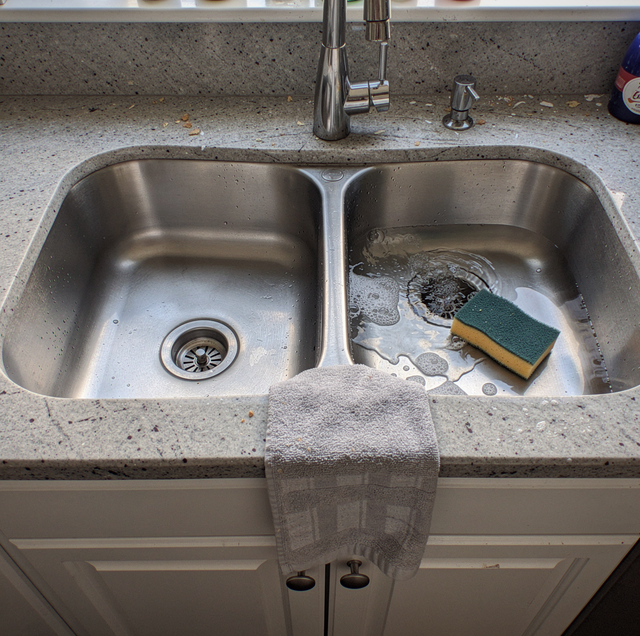
Quick Answer: Water rising in the second bowl when the disposal runs means the blockage sits downstream of where both bowls join, not inside the disposal. How fast it rises narrows the restriction to the tee, the shared trap, or the trap arm.
Flip the disposal switch, and the bowl on the other side of your sink starts filling with water that has nowhere obvious to come from. No tap is running on that side. Nobody is using it. Yet the level climbs while the disposal grinds, then settles back down once it stops.
That detail is doing real diagnostic work, even though it's easy to miss. The instinct is to blame the disposal, since it was running when the water showed up. But the disposal isn't overflowing; the plain bowl next to it is. Two bowls on a kitchen sink typically share one drain line inside the cabinet, and when something narrows that shared path, water pushed by the disposal has to surface somewhere. Tracing that path from each bowl down to where the two lines meet tells you which fitting is holding the restriction, long before anyone opens the cabinet with a bucket and a wrench.
Two Tailpieces Feed One Shared Drain
Each bowl of a double-bowl kitchen sink normally runs its own vertical drain line down from its strainer basket. On the plain side, that's a simple tailpiece: a straight pipe with nothing attached. On the disposal side, the disposal itself does that job. Its horizontal discharge tube is the path ground waste and water take out of the unit and down toward the rest of the drain.
Until those two lines meet, one bowl has no bearing on the other. Water and waste from the disposal stay in the disposal's own line; water from the plain bowl stays in its own line. That's why a disposal working correctly is normally invisible to the bowl next to it. The two sides simply don't interact until something forces them to.
The Continuous-Waste Tee Is Where the Two Lines Merge
Inside the cabinet, a fitting called a continuous-waste tee joins the disposal's discharge tube and the plain bowl's tailpiece into one downward path. This is the first point in the whole assembly where flow from each bowl touches the other.
If that fitting, or the short horizontal run leading into it, is holding even a partial restriction, the merge point narrows. What actually creates that narrowing is its own subject; what matters for this read is what happens once it's there. Flow that used to pass through freely now meets resistance right at the junction, and a surge from the disposal side has to go somewhere. The plain bowl's tailpiece, open and not actively pushing water anywhere, becomes that outlet.
Why the Water Rises in the Bowl That Isn't Running
A disposal doesn't send a steady trickle downstream; it sends a heavier surge with each grind cycle, water and waste released together. If the shared line past the tee is clear, that surge passes through without a trace in either bowl. If something downstream is restricting flow, the surge finds the path of least resistance, and that path is the plain bowl's open tailpiece rather than the disposal's own sealed housing.
How fast that water shows up tells you roughly how close the restriction sits. A sharp, immediate rise, water climbing within seconds of the disposal switching on, usually means the block is right at or just past the tee; the surge has almost nowhere to travel before it meets resistance and turns back. A slower rise, or one that rises only slightly before leveling off, usually means more of the line is still open, and the restriction is farther along, with some volume getting through before backpressure builds enough to show at the surface.
The Shared Trap Catches What Both Sides Send Down
Past the tee, the combined flow from both bowls drops into a single trap that serves the entire sink assembly. What the trap does is hold a plug of water that blocks sewer gas from the branch line. What matters for this read is what feeds into it: debris from either bowl or from the disposal's own grinding can settle in that curve, and it will show the same symptom regardless of which side sent it down.
Whether the water recedes tells you something too. If the level in the plain bowl drops back down fairly soon after the disposal stops, water is still passing the restriction, just more slowly than normal, which points to a narrowing rather than a full stoppage. If the water sits there and doesn't recede, or if both bowls are already slow to drain even without the disposal running, the trap or the line just past it is carrying little to no flow.
The Trap Arm Carries the Merged Flow Out to the Branch Line
Past the trap, a single trap arm runs out to the wall and ties into the branch drain line serving that section of the house. A restriction at the trap arm sits farther from the sink than a clog at the tee or the trap, with more pipe volume between the merge point and the block.
That distance changes the pattern. Rise tends to be more gradual and may take repeated disposal use before it's visible, but once it does show, it tends to hold rather than settle back down, since the whole downstream run is compromised rather than one local fitting. A dishwasher tied into this same line through the disposal's inlet can show a similar lag when the restriction sits this far out, draining slowly or sitting full around the same time the plain bowl is climbing.
What This Pattern Rules Out
Because the water is surfacing in the bowl when the disposal isn't running, the disposal's own working parts are already cleared by the symptom itself. A unit that grinds normally and pushes its discharge into the shared line is doing its job; the grind chamber, the motor, and the mounting assembly aren't what's driving water upward somewhere else. What to do about the unit itself, repaired, replaced, or removed, is a separate decision with its own set of signs to weigh. This one is a plumbing-line question below the counter, not an appliance question.
Running the disposal again while the other bowl is already standing full sends more water into an already-restricted line. It can overflow onto the cabinet floor instead of clearing anything, so let the water settle first.
Repeating the cycle to see if it clears on its own doesn't test anything new. The disposal already showed that its own path is open the first time water surfaces somewhere it shouldn't; the answer lies in the shared line, not in the unit.
Clearing the Shared Line Fixes Both Bowls at Once
Because the restriction sits in a fitting that serves both bowls, one cleared segment resolves the symptom you're seeing in both directions. There's no separate fix for the disposal's side and the other side, because past the tee there is no other side; it's one line carrying flow from both. Snaking or jetting that shared run, from the tee through the trap and out along the trap arm, is drain-cleaning work rather than appliance repair, precisely because the disposal already proved its own path clear the moment it pushed water somewhere it wasn't supposed to go.
Frequently Asked Questions
Most do, but not all. Some installations run two independent traps, one under each bowl, that tie into the branch line separately downstream rather than merging into a single shared trap under the cabinet. In that layout, a clog past one bowl's own trap generally stays isolated to that side, so seeing the classic other-bowl rise is a clue that your sink uses the more common shared-trap setup rather than the twin-trap version.
It can. Disposals are typically run with the cold tap open to help flush waste through the line, so the volume behind each surge is the combined tap flow plus the disposal's discharge, not just what the grinding itself produces. A longer stretch with the tap running alongside the disposal sends more total volume into the shared line per cycle than the disposal running dry, which is part of why the same restriction can show a small rise on a quick cycle and a much higher one if the tap runs longer alongside it.
It can affect timing more than outcome. Kitchen layouts often put the disposal on the bowl closer to the wall stub-out, which shortens the disposal's own run to the tee and leaves the plain bowl with the longer tailpiece run. A longer run on the plain side means slightly more delay before a surge shows up as rising water, even with an identical restriction downstream, so the same clog can appear faster or slower from one kitchen to the next.
Running the tap, not the disposal, on the disposal side while watching the plain bowl gives a cleaner read than running the disposal itself. A near-immediate rise from ordinary tap water suggests the restriction sits right at the tee, since almost nothing has to build up before backpressure appears. A rise that takes longer to develop, even with steady tap flow, points to a restriction farther along the line, past the trap or out at the trap arm.
The single-bowl version of the same problem usually shows up at the dishwasher instead of a second bowl. The dishwasher's discharge merges with the disposal line below the sink at its own junction, so a downstream restriction can push water back up through the dishwasher's air-gap fitting or overflow into the high loop rather than climb into a bowl that doesn't exist. The mechanism reading where the block sits works the same way either way.
Not for whether the water rises. Backpressure travels up through the tailpiece and the strainer body regardless of whether the stopper is seated, so a closed stopper won't stop the level from climbing. What a closed stopper can do is trap water above the strainer basket even after the restriction downstream has cleared, which can make a bowl look like it's still backed up for a while after the actual problem has already passed.
Point a drain tech at the shared line rather than at the disposal — the tee, the trap, and the trap arm are where the restriction gets found and cleared. Ser Plumbing clears drains across the area, from drain cleaning in Downey to Lakewood. Call (310) 953-3566.
