
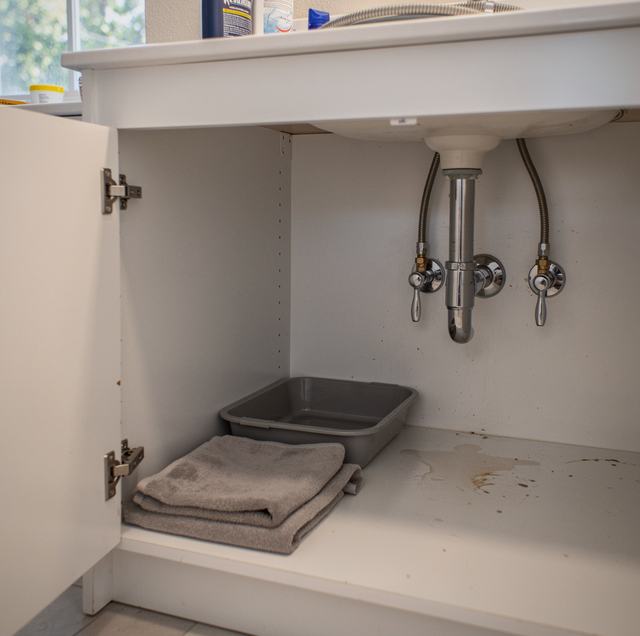
Open the cabinet under the sink and look low along the back wall, where the two supply lines rise. You want the two small handles to sit on those lines, oval- or football-shaped. Turn both clockwise until they firm up and stop. Then open the faucet all the way, hot and cold. Flow should fall off and quit within seconds.
That is the entire procedure when the hardware cooperates. Everything below is for the four ways it does not, and for the case where those handles are not under your sink at all.
What Those Two Handles Are and How to Read Them
The handles sit on the shutoff valves that feed the faucet, one on the hot branch and one on the cold. Facing the cabinet, hot is on the left and cold is on the right, matching the faucet's sides above. Each valve controls only its own side. Both have to close before the fixture is truly dead, which is why a leak that slows but does not stop usually means one handle got turned and the other did not.
Closing a valve cuts the supply, but it does not empty anything. Water is still standing in the flexible connector, in the vertical run below it, and inside the faucet body, and that water has weight and somewhere to go. Opening the faucet provides an outlet and drops the pressure in the line at the same time. A short burst that thins out and quits is the pass. Steady flow that holds its volume is the fail, and it means the valve did not seat.
The two rooms give you different problems getting to the same hardware:
- Clear the cabinet floor completely. Cleaning bottles knock handles part-open without anyone noticing.
- Find both valves and confirm which line each one feeds by following the tube up to the faucet.
- Turn each handle clockwise with your fingers until resistance builds and the handle stops.
- Open the faucet fully on both hot and cold, and watch the spout rather than the valve.
Place a shallow pan and a folded towel under both valves before touching either handle. Water left in the supply line comes out when anything moves, and a wet cabinet floor is easy to miss in the dark.
In a kitchen, the cabinet is deep, and the floor is crowded. A disposal body, a dishwasher hose, the basket strainer tailpiece, and the trap all sit between your arm and the back wall, and the valves usually sit further back and lower than they do in a bathroom. A sprayer hose loops down through the middle of it all.
A bathroom vanity is shallower, and the valves are closer to the front, but the drain hardware fills the center of the cabinet, and your hand has to go around it. A pedestal sink has no cabinet to open. The supply lines run down behind the column to the floor, and the valves sit near floor level behind the pedestal, which usually means working by feel with a flashlight propped somewhere useful.
When a Handle Does Not Close the Valve
Three things go wrong at that handle, and none of them is fixed by turning it more. It spins and never meets resistance. It moves, and a bead of water appears at its base. Or it will not move at all.
What all three mean for you at this sink is the same thing: this valve is not going to close, so the main shutoff below is now your shutoff. Do not tighten anything to chase a weep, and do not work a handle back and forth hoping it reseats.
The weeping stem case needs one more line. Get the pan under it and watch it. A weeping stem only moves one way. It does not reseal itself, and it does not stay slow because it has decided to. Finish closing the valve if it is still moving, then leave it alone and shut off the water at the main before anything else under that cabinet is touched. A valve that weeps every time it is moved is a second failure sitting on top of whatever sent you under the sink.
Never reach for a wrench, a pipe extension, or a hammer to make a stuck valve move. Any of them can snap the valve off the supply line and turn a slow drip into an open pipe under your cabinet.
Penetrating oil and more force belong to the same category. Forcing a seized valve is how a drip becomes a flood, and it happens in the second it takes for the body to give way.
One case is worth separating from the three, because it is not a failure. Some stops close in a quarter turn; others need several full rotations before they seat, and half a turn on that second kind feels like progress and delivers nothing. If the handle is still moving under finger pressure, keep going steadily until resistance builds. If it is not moving, stop.
When There Are No Valves Under the Sink at All
Plenty of sinks have none. The supply comes out of the wall or up through the floor and runs straight to the faucet connector with nothing in between, or one side has a valve from a past repair and the other side doesn't. Utility basins and pedestals turn up this way often, because the plumbing was run to the fixture rather than to a cabinet somebody expected to work inside.
Check both lines before you conclude anything, since a single valve tucked behind a drain tailpiece is easy to miss. If both lines run clean to the faucet with no valve on either, the main is your only option for this repair and for every repair after it. Adding valves during a faucet swap is standard practice for exactly that reason.
The Main Shutoff Is the Fallback
The house main sits where the water line enters the building, which usually means an exterior wall, and often near a hose bibb, since both come off the same entry. Homes with a crawl space or a basement may have it inside, close to where the line rises. Garages and utility closets are worth checking too. Find it on a dry day, when there is nothing on the floor and no reason to hurry.
Two kinds of handle show up. A lever-handled ball valve closes in a quarter turn, and it is closed when the lever sits crosswise to the pipe rather than in line with it. A round wheel handle turns clockwise through several rotations. Either way, turn until the handle stops and then leave it alone; forcing past the stop is the same mistake as forcing a seized valve under the sink.
Closing the main takes the whole house down, so say something first if anyone is in the shower or the dishwasher is mid-cycle. Then walk back to the sink.
Confirming the Main Actually Caught
Open the faucet you were working on, hot and cold, all the way. Then open one more faucet at the lowest point in the house, a tub spout or a laundry basin, to let the vertical runs drain. Pressure drops, the flow thins and quits, and the leak you came for should taper off with it.
Hot water behaves differently, and it catches people out. A water heater holds a full tank, and closing the main does not empty it. That tank will keep feeding the hot side through an open faucet until it runs itself down, so hot water arriving after the main is closed is not proof that the valve failed. Let it run out before you judge.
What it means the valve failed is cold water that keeps arriving at full volume, minutes after the main is closed and every faucet in the house is open. A main that will not seat is not something to keep turning on. At that point the shutoff itself is the repair, and the fixture that started all of this waits its turn.
Frequently Asked Questions
No. The dishwasher gets its own branch off the hot supply, with its own small valve, somewhere in or near that cabinet. Closing the two valves feeding the faucet can leave that branch live, so a dishwasher supply leak needs its own valve closed, or the main valve.
Orientation flips when you view a handle from behind or below, which is how people end up opening a valve they meant to close. Square yourself up to the handle's face first, then turn. Before you start, wrap a strip of masking tape on the handle at its current position so you can return it exactly if you need to.
Probably. A single-handle faucet holds water in both inlet tubes and the mixing body above them, so it drains for longer after the valves close than a two-handle faucet does, and a pull-down spout adds the length of its hose to that delay. Give it a minute of open faucet before you judge the valves.
That valve belongs to the water provider, not to the house, and it usually needs a long curb key to reach and turn. Use the house-side main. If the house-side main will not close and the meter valve is the only remaining option, call the provider rather than working their equipment yourself.
Leave the faucet open while you reopen the valve, and open the valve slowly rather than in one motion. Air trapped in the empty line escapes through the spout rather than slamming into the faucet internals, which is why the first several seconds are spent sputtering and spitting. Close the faucet once the stream runs clean and steady.
Not for pressure — the drain side has none. What it does hold is standing water in the trap and the pipe above it, and anyone in the house running a tap or starting a dishwasher sends more through while that joint is open. Tell the household the sink is out of service; closing the two supply valves does nothing for a drain that is already apart.
Schedule a shutoff valve replacement while the cabinet is still dry — a valve that closes on demand puts you in control of the next leak, rather than the main. Ser Plumbing installs sewer cleanouts across the area, from sewer cleanout installation in Norwalk to Compton. Call (310) 953-3566.
