
Quick Answer: A faucet cartridge is identified by its valve type, stem and spline shape, port layout, length and diameter, and its markings, not by the faucet's brand. Even the right cartridge can reverse hot and cold if seated a half turn out.
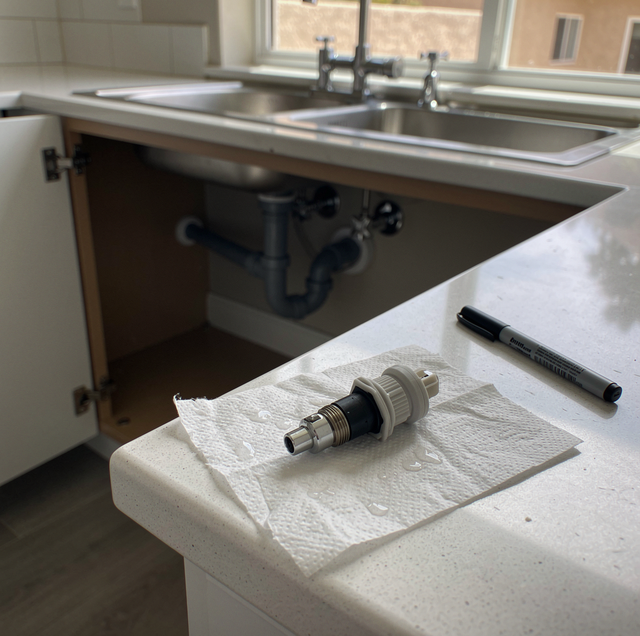
A cartridge sits on a paper towel on the counter, pulled from a faucet that would not stop dripping. It is small and cylindrical, giving away almost nothing at a glance. No visible label, no brand stamp, nothing printed on it that plainly matches anything else in the house. Getting the right replacement back into that faucet is not a shopping problem. It is a matching problem, made by reading the part itself.
Every faucet cartridge does the same basic job: it opens and closes internal passages as the handle moves, sending hot, cold, or a blend of both toward the spout. How that seal wears and how a drip gets diagnosed is its own subject. What matters, with a part already in hand, is which features identify it and in what order to check them.
Before removing an old cartridge, note which side faced the hot inlet and which faced cold, and mark the top edge with a permanent marker. That reference prevents an otherwise correct replacement from being reversed and sent back.
The other thing to settle before the part comes out is the water. A cartridge sits directly in the path the supply lines feed, and the fixture holds line pressure until the stops under the sink are closed and the faucet is opened to release that pressure.
Both stops under the sink close before a cartridge or a supply riser is touched, and the faucet is opened afterward to bleed the line. A retaining clip pulled under pressure sends water across the cabinet in seconds.
How the Valve Inside It Moves
The first thing worth noticing is not the size of the part but how it operates. Some cartridges turn: a quarter turn or so rotates an internal disc- or ball-style element to open the flow and blend the temperature. Others move in a straight line, sliding up and down within the body as the handle is pulled or pushed, opening and closing, with flow through vertical travel rather than rotation.
That distinction sets up everything that follows. A rotating cartridge has its ports arranged around a pivot point, so the openings line up only across a certain range of turn. A push-pull cartridge has ports positioned along its length, timed to open and close as the assembly slides. Two cartridges can share a width and length and still be built around entirely different motions, which is why matching by outward size alone gets only partway there.
Single-handle faucets generally use a single cartridge that mixes both supplies. Two-handle faucets use a separate cartridge on each side, one metering hot and one metering cold, and each sees only its own supply. A cartridge pulled from a two-handle set is not a candidate for a single-handle body, and the reverse is equally true, regardless of how close the dimensions appear.
The Stem and the Splines That Grip the Handle
The exposed end of the cartridge is the stem, which the handle connects to. Running along that stem is a pattern of narrow ridges, often called splines, that mesh with a matching pattern inside the handle or inside a separate adapter sleeve that sits between the handle and the stem. When the handle turns, the splines are what carry that motion into the cartridge.
Spline patterns are not universal. Spacing, depth, and ridge count vary between manufacturers and even between cartridge families from the same maker, and none of it is safely guessed by eye. Some stems are round, with fine ridges running the full circumference; others have a flatter, broader profile with fewer, wider ridges. A handle can slide onto a stem that is close in width and still sit with noticeable play, or refuse to seat fully, because the internal pattern does not match, even though the outside dimension does.
Whether the stem is exposed directly or capped under a separate plastic sleeve that carries the spline pattern outward to the handle is worth noting, too. Some replacement cartridges include that sleeve; others expect the original one to be reused.
Where Water Enters and Leaves the Body
Cut into the side wall of the cartridge are openings, or ports, positioned to line up with matching openings machined into the faucet body around it. One port receives the hot supply, another the cold, and one or more carry the mixed or single-temperature water back toward the spout. Each port is sealed against the body by an O-ring that rides in a groove around the cartridge.
The manufacturer fixes the positions of those ports relative to each other and does not translate across faucet families. A body machined for one port arrangement will not pass water properly with a cartridge whose ports are arranged differently, even when that cartridge otherwise turns and seats correctly in the bore. A mismatched port layout can starve one supply, mix at the wrong ratio regardless of handle position, or block flow to the spout entirely while the handle still turns freely, which can read as a new problem when the actual cause is a part that was never going to line up.
Length, Diameter, and How It Seats in the Bore
Overall length determines how far the top of the cartridge sits once fully seated, which affects whether the handle clears the escutcheon and sits flush. A cartridge that runs long stands the handle proud of the deck; one that runs short leaves it sunken, or leaves too little stem engaged to turn smoothly.
Diameter has to match the machined bore closely enough that the O-ring seals ride against a smooth, consistent wall for their entire travel. A cartridge even slightly narrower than its bore lets water pass around the seals rather than be controlled by them, producing a leak that resembles a failed cartridge but is due to a size mismatch. The cartridge can turn correctly, feel solid, and still leak, because the fault sits in the fit, not the part's internal mechanism.
The Markings That Are and Are Not There
Some cartridges carry molded letters or numbers, cast into the base or along the side during manufacturing. Others leave the surface blank. Where a marking exists, it usually identifies the manufacturer's internal part family rather than a retail model number, so it narrows the search without settling it outright.
A blank cartridge is not necessarily an unmarked one. In hard-water areas, scale and mineral deposits can build up over a marking until it reads as a smear rather than a legible mark, even on a part that left the factory stamped. Reading the surface under good light, after cleaning it gently, is worth doing before concluding nothing was ever there.
Hot Water from the Cold Side After a Faucet Installation
A cartridge can be correctly identified and matched by valve type, stem, ports, size, and markings, yet the faucet can still deliver hot water from what is supposed to be the cold side. Two separate causes produce that exact complaint, and they require different fixes.
The first is orientation. On a single-handle faucet, the cartridge's ports must align with the body's hot and cold openings at a specific rotational position. Seated a half turn out from where it belongs, the same correctly matched cartridge can swap which direction of handle travel calls for hot and which calls for cold, or blend the two so it never delivers full heat no matter how far the handle turns.
The second cause sits outside the cartridge altogether. Supply risers, the flexible or braided lines running from the angle stops under the sink up to the faucet body, carry water from the main to the faucet. If the riser meant for the hot stop is threaded onto the cold stop's outlet, and the other riser is crossed the same way, the faucet shows the same symptom: hot arriving where cold is expected, even though the cartridge inside is seated and oriented exactly as designed.
Telling the two apart means isolating a variable rather than guessing. With the water off at both stops and the supply risers disconnected and reconnected to their original or clearly labeled stops, if the reversal disappears, the risers were the cause. If hot and cold are still swapped after the risers are confirmed correct, the cartridge itself is seated incorrectly and needs to be pulled and reset in the correct rotational position. Confusing the two wastes an attempt at the wrong fix: correcting risers does nothing for a reversed cartridge, and reseating a cartridge that was never the problem leaves the real cause under the sink untouched.
Until the reversal is corrected, treat both handles as capable of delivering water at tank temperature, and read the temperature at the basin, a stream run into the bowl and watched, rather than with a hand under it.
Why the Match Depends on the Faucet Body, Not Just the Part
None of these five features- valve type, stem and splines, port layout, size, and markings- is decisive alone. A cartridge can be an exact stylistic match to what came out and still be wrong in a way that only shows up once it turns in the bore or runs under pressure. The faucet body itself, the casting the cartridge sits inside, is the real reference point that confirms a match.
Faucets from manufacturers such as Moen, Delta, American Standard, and Pfister, among many others, rely on the same handful of identifying features, even though their cartridges are not interchangeable across brands or even within a manufacturer's own product lines. Knowing the name printed on the handle narrows it down very little on its own; the part itself, read feature by feature against the body it came from, is what identifies it.
Frequently Asked Questions
Yes. A manufacturer often reuses the same outer body casting across both single-handle and two-handle versions of one faucet line, so the housing looks identical from the countertop. Inside, the bore depth and the spacing between the hot, cold, and outlet ports differ between versions, so a cartridge pulled from one will not seat correctly in the other, even though the faucet appears to be the same model.
Many single-handle cartridges carry a small molded tab, sometimes called an alignment or witness mark, on the base of the part. It is separate from the splines on the stem, and its job is to key the cartridge to a specific rotational position in the bore rather than connect to the handle at all.
The cartridge is not held in the bore by friction alone. A separate retaining clip or threaded retaining nut, depending on the faucet body, clamps over the top of the cartridge and locks it at full depth. If that clip is left loose, or the nut is not driven down fully, the cartridge can work its way up under water pressure and leak at the base even when it is the correct part.
Some single-handle cartridges include a small integrated check valve on the hot or cold inlet, meant to keep pressurized water on one side from pushing backward into the other line at certain handle positions. It is not a universal feature, and a cartridge with one is not a drop-in substitute for one without it, even if every other dimension matches.
The install is not where it shows. A cartridge seated wrong still takes its retaining clip, still accepts the handle, and still turns through its full sweep, so nothing at the counter signals it. The first run signals it: the handle sweeps the wrong way for temperature, or reaches the end of its travel before it reaches full heat. That is why the water goes on before the handle trim goes back, not after.
Because the width is the shell and the sealing is the grooves, and a cross-reference listing matches the first without guaranteeing the second. A groove set a little high or low lands a seal across a port instead of beside it, and the result is not a leak from the faucet; it is a blend that will not reach full hot or full cold at any handle position. That reads as a bad new cartridge when the part is simply not the same.
Let a licensed plumber match your cartridge and set its orientation correctly the first time — a part identified wrong or seated wrong causes the same complaint twice. Ser Plumbing takes emergency calls across the area, from emergency plumbing in Norwalk to Compton. Call (310) 953-3566.
