
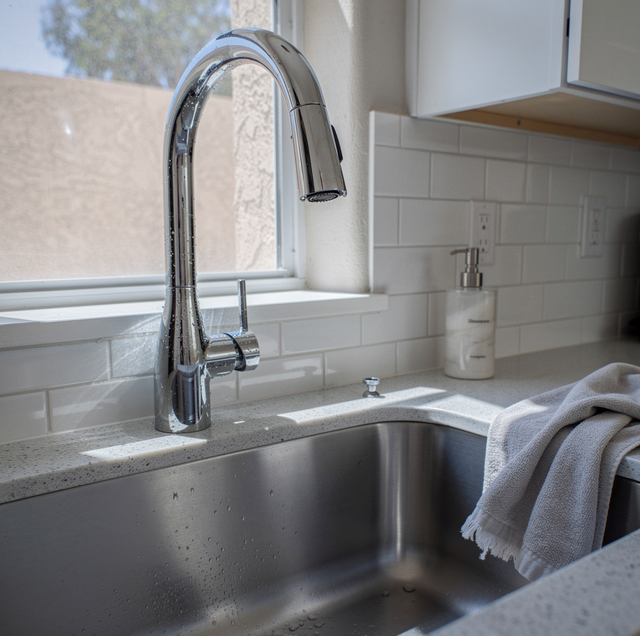
Quick Answer: A faucet that stays dry when off and only wets down while running is leaking from a part downstream of the valve, not upstream. That single distinction narrows the search to a handful of likely spots.
Turn the handle and water shows up right away, tracking down the base of the spout or beading along a seam near the handle. Shut it off, dry the spot with a rag, and wait. Nothing happens. No drip forms on its own, no wet ring spreads while the faucet sits idle. That split, wet only while the water is moving and dry the instant it stops, is not a minor detail. It is the entire diagnosis, because a faucet is not a single pressure zone. It is two, stacked on top of each other, and the valve itself is the line between them.
That is a separate issue from a faucet that drips steadily from the spout with the handle fully closed, which points to wear at the valve seat and is covered elsewhere. This one is entirely about the fixture that is bone dry until you turn it on.
The On/Off Test Sorts the Leak Before You Touch a Wrench
Every faucet has a pressurized side and a flow-only side, and the valve, whether a single cartridge, two separate stems, or an older rotating ball, is the wall between them. Everything upstream, the supply lines from the angle stops and the coupling nuts joining them to the faucet's inlet shanks, sits under full house water pressure at all times, handle up or down. A leak there shows up whether the faucet is running or sitting untouched, because the water pushing on it never stops.
Everything downstream behaves differently. The channel that carries mixed water up through the body, out the spout, and through any sprayer hose only sees pressure while the valve is open and water is moving through it. Shut the handle, and that section goes slack; no pressure pushes on a worn seal, a hairline gap, or a loose connection, so nothing weeps out. That is the mechanism behind a faucet that is dry all night and wet within seconds of the handle going up: the leak sits in the flow-only channel, not the supply lines feeding it.
Confirm this before assuming anything else. Dry every joint you can reach, run the water briefly, and shut it off. If wetness appears only during that window, the search narrows to a handful of specific points: the spout base, the cartridge body, the faucet's casting, the connection under the deck, and the sprayer hose if the faucet has one.
The Swivel O-Ring Where the Spout Turns on the Body
On kitchen and bar faucets, and on bathroom faucets with a swiveling spout, the spout sits on a cylindrical riser and turns freely against the body below it. One or more rubber O-rings, seated in grooves cut into that riser, seal the gap so mixed water travels up through the spout instead of around its base. Those O-rings sit on the flow-only side of the valve: water pressure pushes against them only while the faucet runs.
Running hot water to trace a leak can scald bare skin within seconds. Let the water cool, or use the cold side only, before feeling around a spout base, handle seam, or hose fitting while the faucet runs.
An O-ring in that position gives up its seal quietly, and what identifies it here is not the wear but the timing. It holds at rest and opens only when pushed by moving water, so the same joint reads dry every time you check it with the handle down. Whether the collar underneath the O-ring is still worth sealing is a separate call, covered in the repair-or-replace article.
Spot this one without taking anything apart: wrap a dry hand around the base of the spout while the faucet runs and feel for water working up from underneath, rather than dripping down from the handle above. Wetness starting right at that seam and tracing upward points to this joint as the leading suspect.
The Cartridge Body Seal Under the Handle
A cartridge mixes hot and cold by rotating or lifting inside a bore machined into the faucet body, held there by its own set of O-rings, separate from the seal that controls the valve seat. Those body O-rings sit around the outside of the cartridge, sealing the gap between the cartridge housing and the bore wall so water cannot travel up the sides and out around the handle stem.
That gap sits downstream of where the cartridge opens and closes the flow, so it only carries pressure while the cartridge is turned on. A body O-ring flattened from years of twisting against it, or one nicked during a prior repair, holds fine at rest but lets a thin bead of water past once the cartridge is open and water moves through the bore around it. The result looks like water working out from under the handle base or the escutcheon plate, only while the faucet runs, worsening the longer it stays open and clearing completely the moment you shut it off.
A Hairline Crack or Casting Flaw in the Body Itself
A faucet body is a casting, machined afterward to accept the cartridge, the spout, and the inlet shanks. Casting is not a perfect process, and a void or a thin spot can sit inside the metal from the day it was manufactured, invisible until the water flowing through the body finds it. Because full-flow pressure only arrives once the valve is open, a flaw like this behaves like the seals already covered: dry until the faucet runs, wet within seconds of the faucet running.
A hairline crack can also develop later. Repeated flexing of the body under flow, mineral scale building unevenly inside the casting in hard-water areas, or stress from a prior repair that torqued a fitting harder than the metal wanted can all open a crack that was not there at install. It does not need to be visible; water working through metal this thin often shows as a damp sheen rather than a split.
This is the hardest of the group to confirm without opening things up, since a crack in the casting can mimic a bad O-ring from the outside. If you have already checked the spout base and the handle area and the wetness still traces to the body itself, the casting is the more likely explanation. Whether a body like this is worth repairing or means the faucet has reached the end of its service life is a separate call, covered elsewhere; the job here is to narrow down whether the body is the source.
Below the Deck: the Shank-to-Riser Connection
Not every flow-only leak happens above the counter. On widespread and bridge-style faucets, where the spout and the two handles are separate pieces threaded down through the deck and joined below the counter, the spout has its own riser tube rather than pulling water straight from a valve mounted at its own base. That riser carries the already-mixed water back up from wherever the two supply lines meet beneath the deck, and the coupling nut joining the riser to its shank sits on the mixed-water side of the connection, carrying pressure only while at least one handle is open and water is moving through it.
That coupling nut may have been under-tightened during installation or may loosen slowly as the flexible riser flexes with every use. Either way, the leak shows up as a wet trail on the cabinet floor or the underside of the deck, timed to when the faucet is running, and it is easy to mistake for a drain leak.
Water pooling under a sink is not automatically a supply-side problem: a leak at the trap or the slip joints below the drain is a separate issue with its own fix, and active water right now calls for different first moves than tracing an intermittent drip. This section covers the supply-side connections above and at the deck, not the drain assembly beneath them.
The Sprayer Hose and Its Connection
Not every kitchen faucet has a separate sprayer, but on the ones that do, the hose is one more length of flow-only plumbing. It carries water only when drawn, whether to a side sprayer head or, on a pull-down faucet, out through the head at its end. The rest of the time it sits empty and unpressurized.
The hose fails two ways that fit the pattern. The vinyl or braided cover can crack or split from years of coiling and dragging against the cabinet floor, and that crack only shows when water is flowing through the hose. Or the fitting at either end, where the hose threads onto the spout body or connects to the supply below, can work loose enough to weep under the surge of moving water without disconnecting outright.
Because the hose usually sits coiled out of sight, this one is easy to miss until the cabinet floor is already damp. Pull the hose to its full length while the faucet runs and run a dry hand along it, not just the visible sections, to catch a split before it spreads.
Frequently Asked Questions
Both, and the location of the wet spot is what changes. A bathroom faucet with a spout that does not swivel has no riser O-ring to fail, so the flow-only leaks left on it are the cartridge body seal, the casting, and, on a widespread set, the connection under the deck. A kitchen faucet adds the swivel joint and usually a hose. Same rule, two fewer suspects on a bathroom deck.
Take them out of the running one at a time rather than watching both at once. On a spout base and a handle seam that sit together, running only the cold side loads the full flow path while leaving the hot inlet dry, and running only hot reverses it. A joint that wets on one side and stays dry on the other is fed by that side alone; one that wets on both sits downstream of where the two meet.
Yes, though the part is different. Compression-style two-handle faucets and traditional outdoor sillcocks seal the stem with a packing nut and a fiber or graphite packing washer rather than an O-ring, and a loose packing nut weeps only while the stem is turned or held open. It is not a nut to snug down while the line is live, though: the packing behind it has already taken a permanent set, and torque against a pressurized stem is as likely to open the weep further as to close it. The packing is replaced when the line is dead.
On some faucets, yes. Certain bodies are built as a decorative outer shell fitted over a separate structural valve body, the two pieces held together with a small set screw rather than cast as one unit. A gap between the shell and the inner body can open under the flex of moving water and close back down once the flow stops, looking like an intact single-piece body from the outside.
It can. Pull-down and pull-out sprayer hoses attach at their base with a quick-connect fitting held by a small plastic clip. If that clip seats only partway during installation or a later repair, the fitting can weep even though it appears fully seated and holds under a light tug.
A little. Bridge faucets route mixed water between the two handles through a tube that sits exposed above the counter rather than hidden below the deck, so a hairline seam leak in that tube shows up in plain sight rather than inside a cabinet. It still follows the same rule: the tube only weeps when a handle is open, and water is moving through it, whether the hot side alone or the cold side alone.
Pin a flow-only faucet leak to the exact joint behind it — before it works into the cabinet floor or the drywall below. Ser Plumbing handles burst pipes across the area, from burst pipe repair in Long Beach to Bellflower. Call (310) 953-3566.
