
Epoxy Pipe Lining vs. Repiping: What Each Leaves Behind
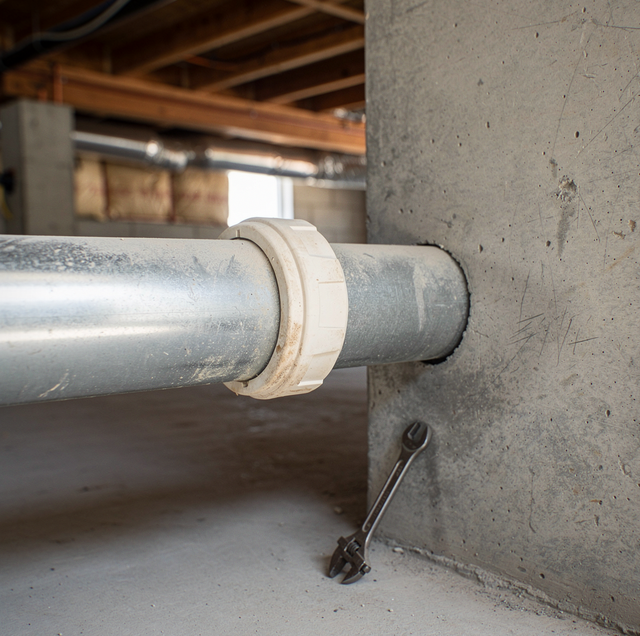
One of these jobs leaves your original pipe in the wall, with a new interior surface bonded to the existing metal. The other takes that pipe out of service for good and runs new pipe to every fixture, often along a different path. Almost every practical difference between epoxy lining and a whole-house repipe traces back to that one split in what stays behind the drywall after the crew leaves.
Quick Answer: Epoxy lining coats the inside of existing pipe and depends on that pipe being sound enough to bond to. A repipe abandons the old line and runs new pipe, moving the demands off the pipe and onto the house.
Epoxy Lining and the Pipe It Needs Underneath
Epoxy lining is a coating job performed on pipe that never moves. A crew isolates a section of water line, cleans the interior down to bare metal, then carries a two-part epoxy through the run under air pressure so it wets the wall and cures into a continuous interior surface. The original pipe continues to perform the structural work. The epoxy becomes the only thing your water touches.
That arrangement makes lining particular about the pipe it is handed. Each requirement below sits in the existing line, and any one can rule a house out before a quote is written.
A continuous bore: The epoxy has to travel the full length of an isolated section under pressure. A hole through the pipe wall, a crushed or kinked segment, or a spot where corrosion has opened a channel gives the material somewhere to escape and leaves a stretch where nothing bonded.
Wall thickness left to bond to: A coating adds an interior surface without returning the metal that corrosion has already carried away. Where galvanized steel has thinned from the inside until the remaining wall is close to paper, there is little sound material for the epoxy to grip and little holding pressure if that coating is ever breached.
An interior that will come clean: Scale, rust tubercles, and old mineral film have to come off first, because epoxy bonds to metal and any debris left in place becomes the weak layer. Hard water armors the inside of older lines with deposits, and the cleaning step is the stage of a lining job most likely to reveal a pipe too far gone to coat.
Ends the crew can reach: Every lined section needs an opening at each end, plus a plan for each branch that leaves the run in between. Where those openings land is set by where the pipe already goes.
What a Repipe Asks of the House Instead
A repipe removes the old distribution lines from service and installs a new system from the main to every fixture. The full scope of that work is a subject in its own right; what matters in this comparison is where its demands fall: in the building itself.
Routing comes first. New pipe wants a path: an attic, a crawlspace, a garage wall, the cavity above a first-floor ceiling. In a slab home with no crawlspace, that path usually runs overhead and drops down into the walls at each fixture, so attic clearance and framing matter more than anything the old pipe does.
Access follows routing. Openings are needed where a drop lands at a fixture, where the new line ties into the main, and where a run changes direction inside a finished wall. Drywall is the third demand, and the one homeowners feel: openings get cut, then patched, textured, and painted back.
A repipe asks a great deal of the house and almost nothing of the pipe it replaces: the condition of that old line stops mattering the moment water stops running through it.
Access and Disruption Compared in Both Directions
Lining is often presented as the low-disruption option, and on some houses it is. On others, the arithmetic turns around.
The number of access points a lining job needs tracks the number of isolated sections, which tracks how the original plumber ran the house. A home with long, simple trunk lines and few branches can be lined through a handful of openings. A home with short runs, many branches, and fixtures on two floors can need as many as a repipe would.
Where those openings land is the sharper difference. A repipe crew chooses its own routing, so openings can often be steered toward a garage wall, a closet, or a low patch of drywall that closes up cleanly. Lining has no such freedom, because the pipe sits where the original builder left it. That can mean an opening in a tiled shower surround, a finished ceiling under an upstairs bathroom, or the back of a built-in cabinet.
Neither job is quiet, and both put a crew in the house for more than a day. The useful question is not which method opens fewer walls in the abstract, but which one opens fewer walls in your house.
Where Fittings, Branches and Transitions Change the Answer
Straight pipe is the easy part for a liner. Fittings are where the two approaches separate hardest.
Threaded galvanized fittings carry the thinnest metal in an old system, because cutting the threads removed wall and corrosion then worked on what was left. The weakest point in the house lies within those fittings, in the very geometry where a coating is hardest to lay down evenly and hardest to verify.
Direction changes: Epoxy moving through an elbow does not lie down the way it does in straight pipe. Thickness varies around the turn, and what a camera can verify past a bend is limited.
Branch takeoffs: A tee splits the coating flow the way it splits the water flow. Branches have to be handled deliberately, and abandoned stubs left by old remodels are a known complication, because the material follows air into places nobody meant to coat.
Transitions to devices: Where the line meets a stop valve, a hose bibb, or the connections at the water heater, the line stops and the original fitting remains in service at whatever age it has reached.
A repipe erases that entire category of question. Pipe and fittings are replaced together, every joint is made the same way by the same crew, and no original connection remains buried in a wall waiting its turn.
Longevity and the Wording on a Warranty
Service life is the first divergence. A coating's working life is bounded by the host pipe beneath it, because that original pipe is still doing the structural work, and no coating can restore the wall that corrosion took. A repipe's working life is bounded by the new material itself, with no older pipe underneath waiting to fail first.
Both methods come with warranties, and the two are not covering the same object.
A lining warranty attaches to the coating: the material, its bond, and the sections that were actually lined. The question to press is what happens when the host pipe fails somewhere the coating never went, at an original fitting, on a section that could not be isolated, or along a branch left out of scope. That is the failure mode a coating warranty most often sets aside, and it deserves a plain answer before signing.
A repipe warranty attaches to new pipe and new fittings installed by one contractor. There is no host pipe underneath whose condition can void the coverage, and when something goes wrong, the question of which part failed has a single owner.
Approval for lining methods varies from place to place and by product listing, so ask the plumber to confirm what your jurisdiction accepts before either method reaches the calendar.
When Lining Is the Only Way to Reach the Run
Some runs cannot be replaced without taking apart something a homeowner will never get back, and those are the jobs where lining stops being the alternative and becomes the answer.
Pipe cast into structure is the clearest case. A supply line embedded in a concrete deck, buried inside a poured wall, or running under a driveway between buildings has no reroute short of demolishing the structure around it.
Irreplaceable finishes are the second case. Original plaster with cast moldings, hand-set historic tile, a terrazzo floor: routing new pipe through those surfaces trades a pipe problem for a restoration problem with no good ending.
Occupied buildings are the third. A repipe in a tenanted duplex or rental has to be staged around the people living there, which is a scheduling problem in itself, and lining is regularly considered where that staging cannot be arranged.
A fourth case is the most common of all: one run is bad, and the rest of the system is sound. Lining that single section leaves the good pipe alone, a defensible use of the method even in a home that would never be a whole-house candidate.
The Condition That Decides Which Is Possible
Everything above converges here. Lining requires a host pipe with enough remaining to be worth coating, while a repipe is indifferent to the shape of the old line. The fork is a question about metal, and it gets answered by looking at metal.
A plumber assessing eligibility works from the inside out. Where diameter allows, a camera shows interior scale, roughness, and whether the bore runs unbroken. A short sample cut from an accessible run tells more than any symptom does: the cross-section shows how much wall remains, whether the loss is uniform or pitted, and whether it is worst in the body of the pipe or at the threads.
A pipe already patched with repair clamps has told you something about its wall. Clamps mark places the metal failed through, and a coating applied over that history addresses the surface while the thin wall around each clamp keeps thinning.
Pipe that has thinned toward failure, that has leaked in more than one place, or whose threaded joints have corroded from within is repipe territory, because no coating restores wall. Pipe whose real complaint is interior buildup, roughness, and discolored water, with sound metal underneath, is where lining has something to hold onto.
Eligibility cannot be judged from outside the pipe, from water pressure alone, or from the house's age. Until someone has looked at the interior and at a cross-section, both methods are hypotheses, and the inspection is what turns one into a plan.
Frequently Asked Questions
Both are lined, using different products. A drain and waste liner carries no pressure, so it is formulated and approved differently from a coating meant for pressurized supply. A contractor who lines sewer laterals is not automatically qualified for potable supply lining, and those are separate approvals worth asking about by name.
Expect a break-in period. The system is flushed at every fixture once a run returns to service, and aerator screens and washing machine filters are usually pulled and cleaned afterward because loosened scale and cleaning residue collect at the first restriction they encounter. Cloudy or off-tasting water beyond that flush is worth a call.
Yes, with a caveat about geometry. The failed length is cut out and rejoined with couplings, and the coating terminates at each cut face. A liner cannot be reapplied at a single point in the middle of a run, so later repairs create short original-to-lined transitions a plumber should note for whoever works on the house next.
The cleaning step removes more bore than the coating adds back. Scale and tubercles in an old galvanized line take up far more of the opening than a thin barrier coat does, so a heavily scaled run usually flows better after lining than it did before. Coating thickness is worth discussing on pipe that was relatively clean to begin with. A plumber measures static and flowing pressure at fixtures before and after, so any change shows up as a reading taken on site.
Long enough to finish a sequence, and no single answer fits every house. Each section is isolated, cleaned, dried with moving air until no moisture remains for the epoxy to fight, coated, left to cure undisturbed, then pressure-tested and returned to service. The drying stage is the one homeowners rarely expect, and it cannot be hurried.
Whatever can be pulled without opening finished surfaces usually comes out. The rest is cut at the ends, capped, and left in place. Ask that the abandoned ends be marked, so a plumber opening that wall years from now does not spend an hour proving a dead line is dead.
Weigh lining against a repipe once someone has looked inside your pipe — a licensed plumber can camera the accessible runs, read the remaining wall, and tell you which method your house qualifies for. Ser Plumbing serves Paramount, Bellflower, and Lakewood. Call (310) 953-3566.
