
Why Commercial Restroom Faucets Fail Faster Than Home Faucets
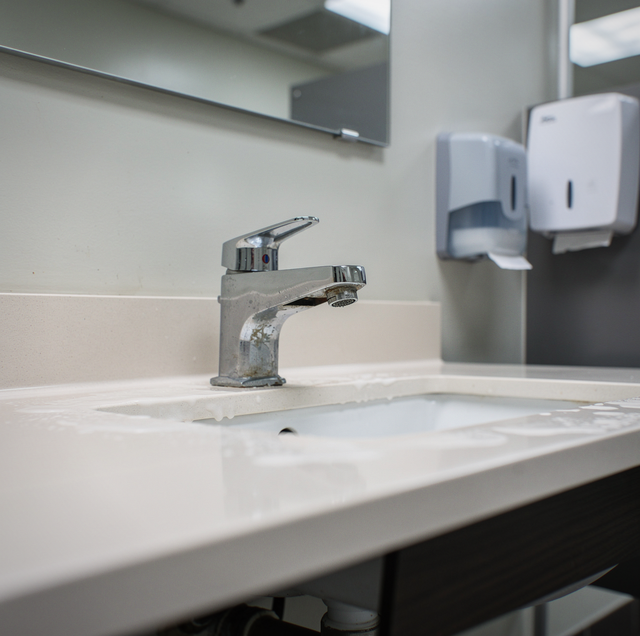
You can hear a hard-used restroom faucet before you look at it. The handle knocks back against its stop, the stream fans sideways where it used to fall straight, and a faint hiss sits behind the escutcheon that was not there when your crew hung the fixture. Put your hand under it, and the water arrives late, then quits.
Quick Answer: A restroom faucet fails sooner because its wearing parts are rated in cycles, not years, and a public building spends those cycles in months. Traffic, closing force, debris, and a different public-use fitting class all push in the same direction.
If you manage a building, you already know this faucet is not the one in your own kitchen, even when it carries the same brand on the spout. You will replace parts in it while the one at your house serves your family untouched for years. That gap is arithmetic, and you can count it in your own building.
The Arithmetic Nobody Runs on a Restroom Faucet
Every moving part inside a faucet has a number attached to it, whether anyone looks it up or not. The cartridge, the stem, the seat, and the O-rings carry a rated number of open-and-close cycles, and the endurance testing behind the supply-fitting standard for faucets runs cartridges through hundreds of thousands of cycles. The number sounds enormous until you put a building underneath it.
Run the division against whatever traffic your property carries. A household lavatory faucet might see thirty or forty operations on a busy day, counting every hand wash, every toothbrush, every rinse of a coffee cup. One faucet in a two-fixture restroom at a medical office, a school wing or a warehouse break area can take that in an hour, and it takes it in bursts: shift change, lunch, the end of a class period. The rating never changed, and the water never changed, but the calendar underneath it collapsed, because the part counts cycles and has no way to count months. A faucet engineered to run for two decades in a house reaches the same cycle total in a year or two of public service. Then it behaves exactly the way a twenty-year-old home faucet behaves: a drip nothing will stop, a handle that turns past its old stop, a stream that wanders off the drain.
None of that is a defect in the fixture, and it deserves to be said before a manufacturer gets blamed. The part performed to its rating. Your building spent that rating faster than a house ever could, and every difference below stacks on the same arithmetic.
What Bends a Faucet's Service Life Before Anything Leaks?
A cycle rating assumes a clean cycle. The fixture on the rating sheet was tested in clean water at a steady temperature, with a machine closing the handle by the same distance at the same speed several hundred thousand times. Your restroom faucet works under none of those conditions, and every departure from them spends the rating faster than you would expect.
Grit comes first. Sand, pipe scale, and solder beads freed by work anywhere upstream travel to the nearest sealing face and get ground into it. A single particle trapped between a moving surface and a stationary one does more damage in one closure than thousands of clean closures do.
Closing force comes second. A homeowner turns a valve until the water stops. A stranger turns it until it will not move, because nobody is gentle with a fixture nobody owns, and the extra torque lands on the stem, on the seat, and on the mounting hardware under the deck.
Public-Use Faucets Belong to a Different Fitting Class
The distinction is not marketing. The supply fitting standard for public-use faucets specifies that public lavatory faucets other than metering faucets must have a maximum flow rate of 0.5 gpm. That metering faucets, meaning the ones that dispense a predetermined volume when activated, must discharge no more than 0.25 gallons per cycle. Those are set limits for a fitting class, not a judgment about what your building has to install.
At the fixture, those limits mean smaller passages. A flow device with a faucet rated at half a gallon per minute has narrower openings than a kitchen aerator, and many public-use outlets are laminar inserts held in with a key. Debris a kitchen faucet would pass without comment shows up here as a split stream, a stream that sprays the vanity front, or a fixture that seems to have lost pressure the building never lost.
The same model name often covers both classes. A public-use version carries a different flow device, sometimes a different cartridge, and occasionally a longer stem. Parts you pull off the residential listing instead of the public-use series will fit the hole and then behave like the wrong part.
Where Metering and Sensor Faucets Change the Picture
A metering faucet takes the human hand out of the timing. Press it, and the cartridge runs a full timed stroke, opening, holding, and closing itself, every activation. The count no longer estimates how long someone held a lever; it equals the number of people who touched the fixture, and the mechanism that runs that stroke does measurable work every time.
A sensor faucet moves the same job to a solenoid behind the deck. The cycles did not disappear. They shifted to a small electromechanical valve that opens and closes exactly according to the building's schedule, plus the activations nobody meant to trigger when a sleeve or a paper towel crossed the beam.
Anything powered on that fixture belongs to a technician. A plumber works the water side, confirms the valve and its supply, and hands the powered components to their own trade. You do not want a maintenance hand opening a control housing to chase a faucet that will not run.
Home Faucet Against Restroom Faucet, Side by Side
Two fixtures can share a spout shape, a finish, and a warranty card and still live completely different lives. The table below is why the work orders never match.
| Home lavatory faucet | Public restroom faucet | |
|---|---|---|
| Daily operations | Tens, spread across a day | Hundreds, arriving in bursts |
| Flow class | Ordinary aerated outlet | Public-use limit, often a laminar insert |
| Who closes it | People who own it | Strangers with no stake in it |
| First failure seen | A drip at the spout | A wandering stream or a dead fixture |
| Spare parts | One faucet, one kit | A bank of fixtures, one common kit |
What the Building Itself Does to the Fixture
Mounting takes a beating a home fixture never sees. Public lavatory decks are often thin solid surface or stainless; the faucet gets loaded sideways every hour, and a mounting nut that works loose lets the whole fixture rock. Rocking works the supply connections underneath, and a slow weep at a supply line is often the first thing a plumber finds below.
Cleaning is the second load. Restroom surfaces get disinfectants and acidic descalers on a schedule nothing in a house matches, and those chemistries reach the finish, the escutcheon gasket, and exposed trim.
Water chemistry finishes the job. Minerals plate out on every wetted surface on the same line, but volume determines how fast the deposit becomes a problem. Your restroom fixture passes many times the water a home faucet passes in a week, so the scale that takes a decade to matter at a kitchen sink reaches a public lavatory outlet in a season, and it lands first on the smallest opening there.
The Uptime Problem a Home Faucet Never Creates
A dripping faucet at home waits for a Saturday. A restroom fixture out of service in a building that serves customers, patients, students, or staff does not wait, and the pressure to get it running lands on you the same morning.
That difference changes how the work gets planned, not how the faucet gets repaired. Fixtures in one restroom are worth keeping identical so a single cartridge kit covers the room. Work is worth staging so one sink stays live while another is apart. A spare trim kit on the shelf turns a closed restroom into a short interruption, because the part is already in the building when needed.
What Bends the Repair or Replace Verdict on a Bank of Fixtures?
Once the arithmetic is visible, the verdict stops being a matter of taste. Five questions carry almost all of it, and you can work through them with the plumber at the sink.
Where the wear sits comes first. Cartridges, washers, seats, O-rings, aerators and diverters are serviceable parts, and a fixture whose complaint lives in those is a repair. A pitted body, a cracked casting, or threads pulled out of the deck mount moves it into replacement.
History comes second, the question most often skipped. A cartridge replaced twice in eighteen months at one sink has told you something the fixture itself cannot: either the count is far higher than anybody assumed, or debris keeps arriving from upstream, and a third swap buys another eighteen months at best.
Parts support comes third. A series still carried by suppliers keeps a fixture repairable for years. A discontinued series with no cartridge behind it is a fixture on borrowed time, however sound it looks.
Standardization comes fourth. A bank of four matched faucets takes less labor and shelf space than four different fixtures, and replacing a whole row at once often stops the recurring calls.
Scalding risk at a public sink is set upstream of the faucet, so have the licensed plumber verify the outlet temperature after any fixture work, before the restroom reopens.
Cycle count comes fifth and is missed most often. Before you agree to any proposal, ask the one question that separates a real diagnosis from a parts swap: what cycle count will this fixture take between now and the next scheduled visit, and does the plan account for it? A plumber who can answer that at the sink is working from your building. A plan without it is a part change waiting to come back.
Frequently Asked Questions
Tie it to your cleaning schedule, not to the calendar of complaints. Many public-use outlets are laminar inserts removed with a key and not by hand, so ask your plumber to leave one key with you and one in your janitorial closet. Pull the insert, soak it, check the screen for scale and grit, and look at the stream before you sign off.
Sometimes, and you cannot tell by looking at the spout. Public-use fixtures often carry a different flow device, and some carry a different cartridge or a longer stem for a thicker deck. Give your supplier the model and series number stamped on your own fixture body, not the name on the showroom box, and confirm the part against the public-use listing before you let your crew take the faucet apart.
Both are defensible, and the split falls on how many identical fixtures you carry. One failure in your matched row of four, with parts still available, is a repair. Two failures within a year in that row, or a series nobody stocks, is the point at which doing the row together stops the recurring calls and leaves you with one cartridge kit covering every sink in your room and one part number on your shelf.
Keep the model and series number, the cartridge part number, the date, and the position in your row that was touched, because your bank of identical faucets loses its history quickly when nobody records which one was serviced. Note who verified outlet temperature afterward, and keep it where your on-call staff can reach it. That file turns your next failure into a five-minute order for you and not a return trip to identify parts.
They ask more of your building. A wall-mount faucet puts its unions inside the wall, so the serviceable connections sit behind the finished surface, and reaching them means an access panel or an opening that has to be patched afterward. Deck-mount fixtures keep their supplies and mounting hardware in the cabinet or under the counter, where a plumber can reach them with your restroom still open. If you are specifying new fixtures for a busy room, ask where the unions land and how somebody gets to them on your worst day.
When every fixture in a room weakens together, the fixtures are rarely the fault, and a plumber works outward from your room before touching a single faucet. The first checks are the supply stops feeding that wall, the flow devices at each outlet, and static and flowing pressure measured at the room, not guessed at the street. Recent work upstream matters here, because a repair, a shutdown, or a heater swap can free-scale that arrives at the narrowest opening in your building, which in a public restroom is these outlets. Ask your staff when the room last lost water for any reason. That date often explains the room in one answer, and it shows you whether the outlets need cleaning or your supply needs attention.
Ask a licensed plumber to walk your restroom banks before the next fixture fails — a commercial plumbing visit can count the cartridges in service, read wear on the stems and aerators, and tell you which fixtures are worth repairing and which are past it. Ser Plumbing serves Paramount, Bellflower, and Lakewood. Call (310) 953-3566.
