
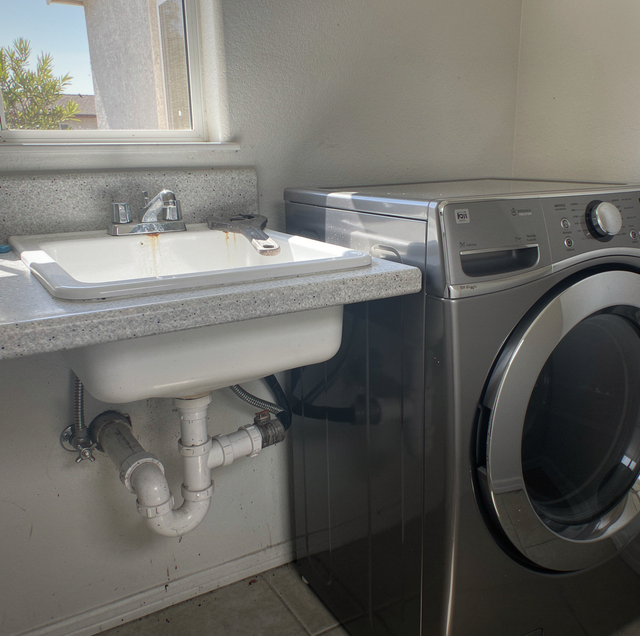
You start a load of towels, walk away, and come back to find the laundry basin filling with gray, sudsy water right in the middle of the machine's drain cycle. Nothing else in the room is clogged. The basin drains fine on its own when you run water into it by hand, and the washer isn't leaking from a hose or a seal. The only thing happening is that every few minutes, exactly when the machine pumps out a load, water shows up somewhere it shouldn't. That timing is the tell: this isn't a clog, it's a connection problem. Somewhere behind the wall, the sink and the washer are tied into plumbing that wasn't built to handle what both fixtures demand at once.
A laundry basin and a washing machine often sit a few feet apart, and it's tempting to assume they can share whatever pipe is closest: one drain, one trap, one vent, one set of shutoff valves. Some of that is true. Some of it isn't, and the difference matters more than it looks like from outside the wall.
The Drain They Are Asked to Share
A laundry sink drains the way most fixtures do: by gravity, at whatever rate you're pouring water in. A washing machine's pump doesn't work that way. When the cycle calls for a drain, the pump pushes the load out in a short, forceful burst rather than a slow trickle. That burst arrives at the shared pipe fast and under real pressure, not sitting there waiting its turn.
A shared branch has a ceiling: Whatever pipe carries both fixtures' wastewater has a fixed capacity, and the washer's pump can briefly ask for far more of it than a basin's slow gravity flow ever does. When the branch can't carry the combined rate, the water takes the path of least resistance: whichever opening sits lowest and closest to the surge, usually the basin.
Where the two lines actually join is normally a sanitary tee, a fitting shaped to direct flow in one direction rather than force it around a hard right angle. That's why the basin fills and not the washer: the washer is pushing water away from itself, and the basin is simply the nearest low point on a line momentarily asked to do more than it can.
The Trap Each Fixture Needs on Its Own
Every fixture that drains into the sewer system needs its own trap: a bent section of pipe that holds a plug of water and blocks sewer gas from coming back up through the fixture. A laundry basin needs a P-trap under the bowl, sized and vented for that basin alone. A washing machine standpipe needs its own trap too, set in the branch that receives the washer's discharge hose, upstream of where that branch ties into the trap arm running toward the main line.
Two separate fixtures do not share one trap. A multi-compartment sink is the exception that proves the rule: it is one fixture, so its bowls join above a single trap via a continuous-waste fitting. A laundry basin and a washing machine are two fixtures, and if the basin's drain and the washer's standpipe tie into the same branch downstream of a single trap, only one of them is actually protected, and the other is relying on borrowed sealing it was never designed around. The fix isn't clever plumbing; it's a plain rule: each fixture keeps its own trap, and the branch that joins them does so after both traps, not instead of one.
Venting When Two Fixtures Tie into One Line
A trap only works if it stays full of water, and keeping it full depends on venting. A vent pipe lets air into the drain system, so a rush of water from one fixture doesn't pull water out of a neighboring trap. Every trap needs an adequate vent behind it, whether or not the two fixtures share a branch.
Where it gets more particular is when a basin and a washer standpipe tie into the same branch close to each other. The washer's fast, high-volume discharge is exactly the kind of event that can pull a neighboring trap's water seal loose if the venting behind it isn't equal to the job. A trap that loses its seal doesn't announce itself with a flood; it just quietly stops blocking sewer gas, and the first sign is usually a smell rather than water on the floor.
Vent capacity for that branch: Depends on the pipe sizes, the run lengths, and how many fixtures sit on it, not something to eyeball from the symptoms alone. That's a sizing question for a licensed plumber looking at the actual branch, not a rule of thumb that travels well house to house.
Splitting the Hot and Cold Supply
Sharing a hot and cold supply is simpler than sharing a drain, but it still isn't a straight swap of parts. A plumber ties into the existing hot and cold lines with a tee on each, then runs a branch to whichever fixture is being added. Past that tee, each fixture needs its own valve, and this is where a laundry basin and a washing machine part ways.
A laundry sink uses angle stops: compact valves designed for slow, occasional flow, turned by hand when you're working under the sink and turned back when you're done. A washing machine calls for a laundry valve instead, either a single-lever body that shuts off both hot and cold at once, or a pair of hose-bibb-style valves, one per line, built to handle full flow and hold up under a supply that stays pressurized between the fill solenoid's openings on the machine's own timer. The two valve types aren't interchangeable. Putting a pair of angle stops behind a washer, or a laundry valve behind a sink, technically threads on, but it's the wrong part doing the other part's job.
That laundry valve is typically mounted directly to the wall rather than recessed, keeping the shutoff visible and easy to reach without added framing. Braided stainless supply hoses belong on the washer side regardless of which valve sits behind them; they hold up to years under pressure far better than the rubber hoses a machine ships with.
Standpipe Height versus Draining the Hose into the Basin
The standard way to handle a washer's discharge is a standpipe: a vertical pipe, open at the top, tall enough that the pump has to lift water up and over the lip before gravity takes it down to the trap below. That height keeps water from draining back down the hose between cycles and gives the pump discharge somewhere to arrive besides directly into open plumbing. How tall it needs to be varies by machine and drain layout, a manufacturer-and-plumber question, not a fixed number worth copying from another install.
Running the washer's drain hose over the rim of the laundry basin rather than into a standpipe looks like the same idea, and it is sometimes treated as an acceptable substitute, but the failure modes differ. The hose isn't secured the way a standpipe connection is, so a hard pump discharge can work it loose or shift it out of the basin over time. If the hose end sits low enough to touch or submerge in water already in the basin, water can siphon back toward the machine between cycles instead of staying put. And the basin's own strainer and tailpiece, built to catch what a person rinses down a sink, end up filtering lint and fine debris from every wash load instead, a job they weren't sized for.
A washer's pump discharge arrives in a hard, sudden burst. A drain hose resting loosely over a basin's rim, rather than secured into a standpipe, can whip free under that pressure and send wastewater across the floor.
What Suds and Lint Returning to the Basin Are Telling You
If suds or flecks of lint show up in the basin while the washer is actively draining, rather than simply draining slowly afterward, that's information about where the two fixtures actually tie together, not just a mess to wipe up. Wastewater moving into the basin during the discharge means the washer's tie-in point sits upstream of the basin's own drain opening on that shared branch, so the surge has a path back into the basin before it ever reaches the trap and the line beyond it.
That differs from a basin that simply drains slowly after the wash cycle, which usually points to ordinary buildup past the strainer. Suds and lint arriving during the cycle on a basin that otherwise drains fine point to the physical layout of the tie-in rather than anything blocking the pipe. Reworking that tie-in point is plumbing work, not a maintenance step, and it's worth having a plumber inspect the actual branch before assuming a larger pipe or a different hose is the fix.
Why the Requirements Vary by Setup
Standpipe height, trap arm length, and the amount of venting a shared branch needs all vary with the fixtures involved, the pipe sizes already in the wall, and how the two drains are laid out. None of that is a fixed number worth copying from a different house, and getting it wrong- a standpipe too short, a trap arm run too long, a vent sized for one fixture instead of two- is what turns a setup that works today into one that backs up next month.
A licensed plumber can look at what's actually behind the wall: the branch size, the trap locations, the vent run, and the two supply lines, and confirm what that specific setup needs rather than what a general rule suggests. Sharing a laundry basin and a washing machine's plumbing isn't inherently a problem. Sharing it without confirming the drain, trap, vent, and supply were sized for both fixtures together is.
Frequently Asked Questions
Not typically. The standpipe is what already prevents it: its height means the pump has to lift water over the lip, and there is no continuous column left for a siphon to pull on. A check valve adds a flapper that lint works into and holds open, which is worse than the problem. Where a hose must discharge into the basin instead, the hose end is secured above the basin's flood-rim level so it never sits in standing water.
Adjacency is what makes people assume it, and drain load is what usually rules it out. Whether the arrangement works depends on which fixture sits upstream of which, and on how much water is moving through that shared section when the upper fixture needs air. A washer's pump discharge fills the pipe for several seconds at a stretch, which is exactly when the basin's trap needs it clear. Pipe size and the total fixture load on the branch decide the answer. Those requirements vary, and a licensed plumber confirms what applies.
Not usually. A laundry basin's drain opening is sized for a standard sink tailpiece, while a washer standpipe is sized for the machine's discharge hose, and the two are rarely identical. Where they join a shared branch, a reducing bushing or a flexible coupling adapts between the two diameters rather than forcing one fitting to serve both.
Often, yes. A single-lever laundry valve shuts hot and cold with one motion, so there is one mechanism to keep free instead of two that both have to cooperate after years of never being turned. That matters more than it sounds, because a laundry valve is opened once at installation and typically not touched again until something has already gone wrong, and the moment it is needed is usually a burst hose with water already moving.
No. A floor drain is sized and trapped for what reaches the floor: a slow seep, a mopped spill, the spreading tail of an overflow that has already happened. It is not sized to receive a pump discharge, so a hose aimed at one is not a substitute for a standpipe. It also sits at the low point of the room, which means anything it can't swallow fast enough comes back up onto finished flooring rather than staying inside a pipe.
A laundry faucet closes under a hand that can feel the line, a few times a day at most. A washer's fill valve is a solenoid that snaps shut in a fraction of a second, dozens of times a month, on a machine nobody is standing at, and that repeated shock is what works fittings loose over years. A water hammer arrestor absorbs it at the valve. A utility faucet on the same wall can bang the pipe too, which is why an arrestor near the fixture is worth adding whenever that wall is already open.
If the basin fills every time the washer drains, the answer is behind the wall rather than in the basin — a licensed plumber traces the branch, the two traps, and the vent before anything gets replaced. Ser Plumbing repairs sewer lines across the area, from sewer line repair in Norwalk to Compton. Call (310) 953-3566.
