
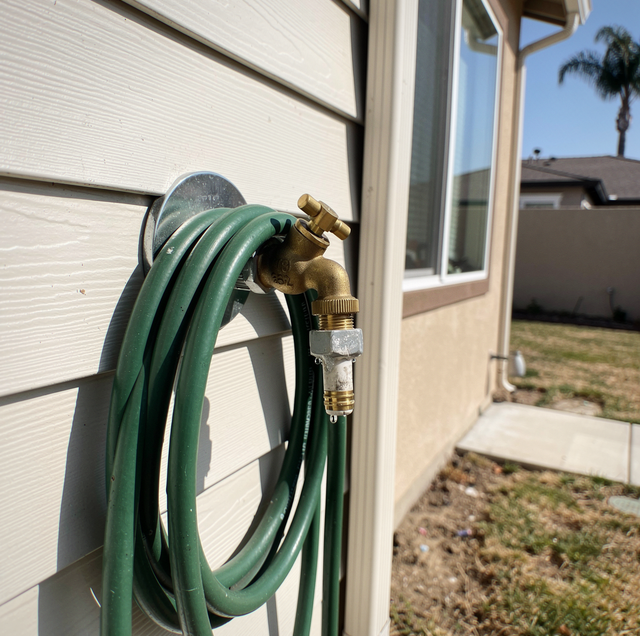
Quick Answer: A hose bibb usually needs replacing, not just repair, when the spout moves at the wall, a hose seizes onto the threads, or outdoor flow stays weak. Each points to the connection behind it, not just the fixture itself.
You reach down to unscrew the garden hose from the spigot, and instead of the hose letting go, the whole faucet turns with it. The spout rotates in your hand as if it were never fastened to anything at all. For a moment it can feel like a stuck fitting finally coming loose, then you notice it is not just the hose moving. It is the entire body of the faucet, spout and all, twisting against the wall.
A hose bibb is not built to move like that. When it does, the joint that gave way is not between the hose and the spout. It is the one behind the siding, where the fixture threads onto a stub of pipe you cannot see. That hidden joint is doing more work than most people realize, and once it starts to fail, the next twist of force applied at the spout is what finishes the job.
The Hidden Connection Behind Every Outdoor Faucet
An outdoor faucet is really a lever arm bolted onto a length of pipe. The handle and spout sit outside, where they take the weight of a hose, a sprayer, or a coil left hanging on the spout itself. All of that turning force transfers straight back through the faucet body to wherever it connects to the water line, usually a threaded or soldered joint sitting inside the wall cavity, out of sight.
This is different from a bibb that keeps passing water after the handle is turned off. That is a seat-and-packing problem, a separate conversation. What matters below is the connection itself: whether the pipe behind the fixture is still sound, and whether it can take another season of hoses screwed on, cranked off, and left hanging.
Three symptoms raise that same question. The faucet spins instead of holding still. A hose will not release from the spout. Or water trickles out when the rest of the house has normal pressure. Each asks the same thing a different way: is the pipe behind this wall still doing its job?
When the Whole Faucet Turns with the Hose
A hose bibb that rotates freely at the wall has lost its grip on the pipe stub behind it. If the spout is already moving, close the house main before anything else touches it. A stub that lets go behind the siding puts water into the wall cavity rather than into the yard, and on most outdoor lines the main is the only control the homeowner has. Where the spout is threaded onto that stub, years of hoses being unscrewed from that spout back the fixture out a little at a time, since the same counterclockwise turn that frees a hose also loosens the bibb from the pipe. Once it backs off past a certain point, nothing holds the fixture rigid anymore except the pipe itself, which is carrying a load it was never sized for.
If the spout spins under light effort, or a hose will not turn by hand, stop and close the main. A wrench or pliers on that connection can snap the pipe inside the wall, flooding the cavity behind the siding.
A bibb that spins means the wall connection has already backed off enough to move under normal hand pressure. What it has not told you is how much material is left holding that joint, or whether the stub of pipe is still solid where it enters the framing. A licensed plumber does not test that by pushing harder either. The next step is to have the connection opened up and inspected from inside the wall, where it can be repaired properly rather than guessed at from the outside.
When a Hose Will Not Let Go of the Spout
A hose that will not unscrew from an outdoor faucet is usually held by mineral scale rather than rust. In hard-water areas, the film left behind on brass threads by evaporating water builds into a crust that locks the hose fitting and the spout together almost as effectively as a permanent joint. From the outside, a seized hose can look like a completely different problem from a spinning faucet. Mechanically, it is closer than it looks.
Working a stuck hose free by hand or with a tool applies rotational force to the spout, and the spout has nowhere to send that force except down into the same wall connection described above. There is no way to tell from outside whether the joint behind the fixture is still sound or has already backed off, and a seized hose gives no warning either way. That uncertainty is the reason to treat a seized hose the same way as a spinning spout: stop applying force to the spout, and have the connection behind the wall checked before anything else is turned.
Low Water Pressure at an Outdoor Faucet
Weak flow at a single outdoor tap while the rest of the house runs normally puts the fault on the branch serving that fixture rather than on the house supply. A hose bibb also offers nothing at the spout end to unscrew, clean, and reinstall, so the suspects all sit behind the wall. A hose bibb has no aerator. There is no small screen to remove and rinse, so the usual first move for weak indoor flow does not apply outside, and the actual suspects are different.
The bibb's own seat and stem: Corrosion or mineral buildup inside the valve body can restrict flow even when the handle turns freely, and the fixture is not dripping.
A supply line pinched behind the wall: Where the branch turns up into the cavity, a soft copper or PEX run can be crushed against framing during earlier work, and that narrowing shows up only at the one fixture it feeds.
A long or undersized branch run: The pipe feeding an outdoor faucet is often a smaller branch off the main line, and on a long run, that undersizing shows up as weak flow at the far end first.
The connection itself backing off: A stub thread that has loosened enough to let the fixture move can also unseat its sealing surface, dropping flow at the spout before any water shows outside. That puts weak flow in the same category as a spinning spout.
Weak flow rarely means the same thing twice. It can be the fixture, a pinched supply run, the branch line, or the connection itself, and telling them apart from the spout end alone is unreliable.
Signs the Wall Connection Has Already Failed
Because the connection this article keeps pointing to is inside the wall, much of the evidence appears indoors before it appears outside. A damp patch on the interior wall behind the faucet, a musty smell near the closest baseboard, or insulation that stays damp longer than it should after the faucet is used are signs that water is leaking past the joint rather than staying inside the pipe.
Outside, the tells are smaller: a faucet with slightly more play than it used to have, a spout sitting at a different angle than it used to, or water beading at the base of the fixture against the siding rather than only at the spout opening. None of these alone proves the connection has failed, but paired with a spinning spout, a seized hose, or flow that has quietly dropped off, they point the same direction.
Why Replacement Solves What Force Cannot
A repair that only addresses what is visible from outside, swapping parts at the handle end, does nothing for a joint that has already backed off its threads or a pipe stub that has started to crack. Those problems live behind the wall, and fixing them means opening that section up, inspecting the stub, and reconnecting the fixture to solid pipe rather than to whatever thread is left.
Replacement also allows something a repair does not: swapping a standard hose bibb for a frost-free style where one is not already in place.
A hose bibb that spins, a hose that will not release, and flow that has faded are not three unrelated repairs. They are three ways the same underlying connection asks to be checked, and a plumber who opens the wall to look at it once can usually address all three at the same time.
Frequently Asked Questions
A hose bibb is held to the house two ways: the water connection itself, and a separate mounting flange screwed into the sheathing next to the pipe penetration. The flange keeps the body from twisting when a hose is turned. When it is missing, undersized, or its screws have lost their grip in the sheathing, the pipe connection becomes the only thing holding the fixture in place, and normal hand pressure is enough to make it spin.
Yes. A stub that worked loose over the years can fatigue and crack at the thread root instead of simply backing out, and the two feel identical from the outside: both let the fixture move more than it should. The distinction matters at repair time, because a cracked stub has to be cut back to sound material and rejoined, while a thread that has only loosened can sometimes be remade on the pipe already there.
Sometimes. Watch for a hairline crack in the siding or stucco right around where the pipe enters the wall, or a faint discolored ring in that same spot. Movement at a failing connection tends to work the exterior sealant loose before it works the pipe joint loose enough to actually weep water, so a crack or a ring at the penetration point can show up well before any dripping does.
No. Mineral scale from hard water is the most common cause, but a hose left threaded onto a brass spout for an extended period can also bond due to galvanic corrosion, a reaction between the brass fixture and a steel or aluminum hose fitting that forms its own crust at the threads. It behaves differently from scale and can seize a hose even where the water is not especially hard.
It can be. A two-way splitter, an always-attached timer, or a soaker hose left connected at the spout all add downstream resistance to the bibb, and that resistance can feel exactly like weak flow from the fixture. On a bibb that already spins or has a hose seized to it, though, do not twist anything off the spout to find out. Close the main first and have the wall connection checked, because the same rotation that backs a splitter off is what finishes a failing joint.
Only on some houses. Where a home sits over a crawlspace or has an unfinished basement ceiling, the supply line feeding an outdoor faucet is often visible for a short run before it turns up into the exterior wall, and that section is sometimes the only place the connection can be seen without cutting siding or drywall. On a slab-built house, there is no such run, and the wall is the only way in.
A hose bibb that moves in the wall is a connection failure, not a fixture annoyance — the pipe behind the siding gets opened, inspected, and rebuilt on sound material. Ser Plumbing replaces cast iron sewer lines across the area, from cast iron sewer replacement in Norwalk to Compton. Call (310) 953-3566.
