
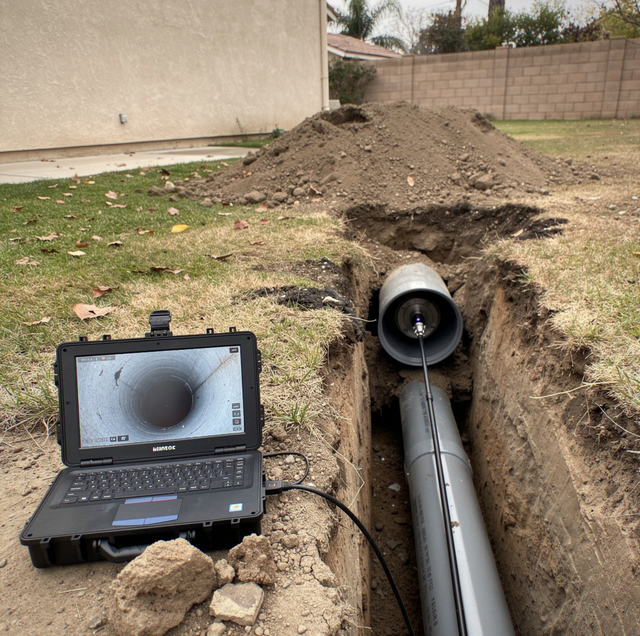
"Belly" on a sewer camera report identifies one specific issue: a stretch of the lateral that has dropped below grade on either side of it, so instead of continuing downhill at the same slope as the surrounding pipe, that section runs flat or dips. Waste and water pool in the dip rather than passing through it, and whatever settles out of that water stays behind after the flow moves on. The word on the report describes a condition and opens a set of decisions: how long the dip has been there, how much it is collecting, and whether the section gets watched, reset, or replaced depends on what the rest of the footage shows around it.
The footage patterns, and the direction each one leads the repair:
| What the Footage Shows | What It Means for the Line |
|---|---|
| A short dip with a skim of standing water | The grade is only slightly off; the section can be watched and cleared on a set schedule |
| A long dip where the camera head goes under | The sag runs deep enough that sectional replacement with the grade reset is the direction |
| Paper, grease or sludge visibly collecting in the dip | The low spot is already fouling; sectional replacement with the grade reset is the direction |
| A dip at a joint that has also offset or opened | The joint has failed along with the grade; sectional replacement with the grade reset is the direction |
| A dip with roots growing in at that same joint | Two separate problems sit at one spot; sectional replacement with the grade reset is the direction |
| A dip that reads deeper or longer on a repeat scope than it did before | The sag is progressing; replacement of the run is the direction |
How a Line Loses Its Grade
A sewer lateral is laid at a steady downhill slope so gravity, not pressure, moves everything through it. That slope depends on the bedding underneath holding the pipe at the angle it was set. A few different things can let that bedding give way. The soil beneath a section can settle over time, especially if it was not compacted evenly during trench backfilling. A nearby joint that has been leaking can gradually wash soil out from under the pipe, so the ground under the sound pipe loses support even though the failure started elsewhere. And weight from above, whether that is digging equipment working near the run or a heavy load sitting on the ground over it, can push a section down that the soil could hold on its own before that load arrived. None of these is the only way a line loses its grade, and more than one can be at work in the same stretch.
What Sits in a Low Spot and Why the Same Stoppage Returns There
Once a section sits below grade, whatever the household sends down slows as it crosses the dip instead of clearing it. Water pools there between uses, and solids that would otherwise ride along in the flow drop out and stay in that standing water: paper, grease that has cooled and thickened, and fine sludge all settle at the low point first. A clearing removes what has built up, but it does nothing to the grade itself, so the dip remains to collect the next round once the line goes back into daily use. When a belly backs the line up into the house, running water and flushing stop until it is cleared, and anything the backup soaked is handled with gloves and cleaned or thrown out, since raw sewage carries pathogens.
A backed-up line can hold sewage under pressure behind a cleanout cap, and opening it can spray raw sewage carrying pathogens. The plumber opens the cleanout and clears the line, and no chemical opener goes into a line already backed up.
A stoppage that returns at the same spot after each clearing is one sign that clearing alone has reached its limit, and at a belly, the dip itself, not the material sitting in it, is what the next visit needs to address.
How the Dip Is Judged on Camera
Reading a belly off the footage is a matter of degree, not a single measurement. How far the standing water rises against the pipe wall says something about how far the section has dropped: a skim across the bottom is a shallower loss of grade than a pool that rises close to the top of the bore. How long the flooded stretch runs is also read, since a long dip holds more standing water and more of the line's flow sits still in it than a short one of the same depth. The material the pipe is made of also factors in, since it affects how the section is likely to behave during repair and how much service life the surrounding run has left. And the joints on either side of the dip get their own look, since a belly sitting inside otherwise sound joints is a different case from one where the joint at either end has also moved. Reading a belly this way means weighing several signals together rather than reading off one number, and that combined picture is what sets the direction.
Why Cleaning, Jetting and Lining Leave the Dip Where It Is
None of the tools used to restore flow correct the grade underneath. A cable clears what is sitting in the dip without touching the soil that let the pipe drop. Hydrojetting scours the pipe wall clean with high-pressure water, which is thorough on buildup but does nothing to correct where the pipe itself sits. Lining forms a new interior sleeve that cures in place inside the existing pipe, and it takes the shape of whatever it cures inside, so a lined belly is still a belly wrapped in a liner. Lining itself is carried out by qualified partner specialists once a section is graded as a candidate for it, and it is not the answer; rather, a dip has to be corrected rather than sealed. Whichever tool restores flow today, the grade stays exactly where the report found it until the section is physically reset.
Resetting the Grade on the Section
Correcting a belly means physically changing what the pipe sits on, and that only happens by opening the ground over the sagging stretch. The section is excavated down to the pipe, the old bedding is removed, and new bedding is compacted under it to the grade the rest of the run is holding. The pipe is relaid at that slope rather than dropped back into the same low spot, and the trench is backfilled after the camera run described next.
An open sewer trench is a collapse and entrapment hazard. Only the crew enters it, with its walls shored or cut back, and only long enough to set the new bedding and pipe before backfill closes the cut.
A camera run afterward confirms the new section is on grade and that water moves through it at the same rate as the rest of the line before the site is closed up.
When the Whole Run Gets Replaced Instead
A sectional reset works when the sag is confined to a single stretch, and the pipe around it is otherwise sound. That is not always what the footage shows. A dip that reads worse on a repeat scope than it did before shows the ground under the line is still moving, and a single reset section would sit on that same ground; where the movement runs along the lateral, new bedding and pipe along the whole run is the direction. A run where several dips or aging joints turn up along its length leads the same way, since resetting one low spot while the rest of the line is in similar condition leaves the same repair still ahead. In either case, replacing the run puts the entire lateral on a single, consistent grade rather than patching a single low spot in an otherwise aging line.
Frequently Asked Questions
Not by themselves. Roots enter through a joint that has already opened, and a belly forms where the ground beneath a section gave way; the two can land at a single joint independently, and the leak that drew the roots can also be the one that washed the bedding out. Either way, clearing the roots leaves the dip in place.
Not exactly. A repair section can run a short distance past each end of the flooded stretch, into pipe that is still reading on grade, so the ground that gets opened is a bit longer than the water alone shows on the footage. That margin gives the new bedding something solid to tie into on both sides, rather than ending the reset right at the edge of the sag.
Yes. How much water is sitting in a dip depends on how recently the line was cleared and how much was flowing through it right before the camera went in, so one scope is a snapshot rather than a fixed reading of the sag itself. What matters across scopes is whether the flooded stretch itself has changed.
No. A grade reset only corrects the stretch that was excavated. A separate dip, an offset joint, or a root entry point further down the same run is unaffected unless it was scoped and included in the repair plan, so a stoppage returning after a reset warrants another camera look rather than assuming the same repair missed something.
Not always. Excavation can turn up a second contributing factor that did not show clearly on the video, such as bedding that reads intact on camera but is soft or partly washed out once the pipe is exposed. The footage sets the plan; opening the ground is what confirms it and can extend it.
Because a belly holds a pool only as deep as the dip, and water arriving from upstream rides over that pool and flows on, so the fixtures in the house can drain at full speed while the low spot stays full. The report is reading the grade, and that standing pool is where paper and grease settle out between clearings.
Engage sewer line repair on the sagging section — camera-verified diagnosis, grade reset and rebedding, and a post-repair camera check. Ser Plumbing serves Paramount, Bellflower, Lakewood. Call (310) 953-3566.