
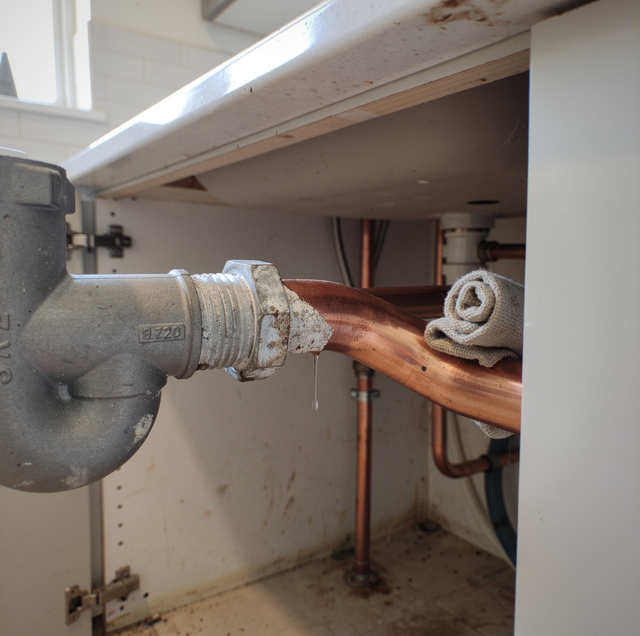
The leak is at the spot where the dull gray pipe transitions to copper, beneath a layer of corrosion, and it is the same joint that was patched once before. Bad luck and a rushed patch can play a part, but the steady cause is two different pieces of metal doing what they do when water sits between them, on steel that is also wearing out from the inside. Knowing how that works helps you and a plumber judge whether the next fix should be a fitting or a section of pipe.
Two Kinds of Corrosion Meet at One Joint
A galvanized-to-copper joint presents two separate problems that happen to show up in the same place, and mixing them up is one reason a repair at this joint can fail.
The first is galvanic corrosion, which occurs only when the two metals are in contact. Steel and copper sit at different points on the scale that predicts which metal gives up electrons to the other in the presence of water. Steel is the one that gives them up. Once the galvanized pipe and the copper pipe are joined directly, with water acting as the path between them, the steel side becomes the sacrificial one and the copper side is largely protected. That reaction is concentrated near the actual connection because the current it generates weakens with distance from the joint.
The second is corrosion that needs no copper at all: the galvanized pipe corroding on its own, the way galvanized pipe corrodes everywhere along its run, joint or no joint. The next section covers that process on its own because it explains why the pipe arriving at this joint may already be compromised before the two metals ever start reacting.
Both processes attack the same short stretch of steel. That overlap lets a joint like this fail again, even after a plumber replaces the visibly bad section: whichever mechanism is addressed, the other is still working.
What Is Already Happening Inside the Galvanized Pipe
Galvanized pipe is steel with a zinc coating bonded onto the inside and outside of the tube. The zinc provides the steel with a sacrificial layer of its own, corroding in the steel's place until the coating is used up.
Water moving through the pipe over the years wears down that interior coating. Once the zinc is gone in a given stretch, the bare steel underneath is exposed directly to whatever the water carries, and steel exposed to moving water rusts. That rust does not wash away cleanly. It builds up on the pipe wall as tubercles, small mineral-and-rust mounds that narrow the bore and roughen the interior surface. In hard water, a layer of mineral scale can also build over that rust.
This process runs the length of whatever galvanized pipe is still in the house, not just at the joint. A galvanized-to-copper transition sits atop that ongoing decay; it does not cause it, and fixing the transition does not slow it elsewhere along the line. That distinction matters when you get to deciding what needs to happen at the joint versus what needs to happen to the pipe around it.
The Threads Cut into That Wall Add a Third Weakness
Copper pipe is joined by sweating a fitting onto the outside of the tube, which adds a fitting without removing any of the pipe wall underneath it. Galvanized pipe is joined by threading, and threading works the opposite way: a die cuts a spiral groove directly into the pipe wall so the fitting can be screwed on.
That cut removes metal. The wall at a threaded connection starts out thinner than the walls a few inches away on either side of it, before either of the corrosion mechanisms above has done anything. It is also where a wrench applies torque during installation and every time a fitting is worked on afterward, and the root of the threads is where that torque and any later bending concentrate.
Put the three together, and the clustering at this spot follows. The wall is already thinner there from the threading. The interior corrosion described above is attacking that wall from the inside, as it does along the rest of the pipe. And the galvanic reaction is adding its own draw on the steel specifically at the point where it touches copper. None of the three needs the other two to be real; they simply land on the same few inches of pipe.
What a Dielectric Union Changes, and What It Leaves Alone
A dielectric union is a fitting built to break the electrical path between the two metals. It uses a plastic lining or an insulating washer to keep the steel and the copper from touching directly, so water can still flow through the fitting, but the current that drives galvanic corrosion has nowhere to complete its circuit.
Installed correctly, on sound pipe, that fitting does what it is meant to do: it interrupts the reaction described in the first section. It does not address the second or third. It cannot restore wall thickness a die already cut away at the threads, and it does nothing about the zinc coating wearing off further down the same run of galvanized pipe. A dielectric union on a section of pipe that is already thinned at the threads or already tuberculated on the inside is preventing one of the three mechanisms from operating while leaving the other two exactly as active as they were.
If a dielectric union is already installed at this joint, ask that it be inspected too. Its galvanized-side threads corrode the same way the pipe's threads do, and an old union may be the part failing now.
How a Partial Repipe Moves the Joint
One repair replaces the failed section: cut out the corroded galvanized stretch, run copper in its place, and stop the leak. That fixes the leak in front of you. It also creates a new galvanized-to-copper joint where the new copper ends and meets the old galvanized. Where the replacement is plastic, the new joint loses the galvanic reaction but keeps the threads cut into old galvanized and the corrosion inside it.
With copper, the new joint starts the same three-part process at its new spot, on the wall of whatever old galvanized it is threaded into. If the galvanized pipe upstream of the repair is the same age and condition as the section that just failed, that new joint starts on steel that has already worn as far as the steel that leaked. A repair like this holds where the surrounding pipe still has sound wall left, and it can fail again where the pipe around it is in the same state as the section that just leaked. The condition of the galvanized pipe at the new joint, and whether that joint is isolated, determine which of the two occurs.
Choosing Between a Transition Repair and a Wider Repipe
The decision at this point comes down to how much of the house still runs on galvanized pipe and what the joint in front of you looks like.
At this joint, the plumber's read is specific to the transition: how deep the original threads were cut into the galvanized end and how much wall is left under them, whether the bore right at the fitting is open or closed down with tubercles, and whether any zinc is left on the steel there. The threads sit inside the fitting while the joint is assembled, so those answers come once the joint is apart.
That inspection gets weighed against how much galvanized pipe remains in the rest of the house and how it has behaved. A house whose supply lines were copper or plastic to begin with has no galvanized runs for this joint to form along, though it can still have steel meeting copper at the water heater's connections, which take a dielectric fitting of their own. An older house that still carries its original galvanized supply lines is a different case, because a joint failure there is one data point on pipe that has been aging along its whole length. A single failed joint on a system that has already had the bulk of its galvanized pipe replaced can reasonably be addressed with a transition repair using a dielectric union and stopped there. A failed joint that turns out to be one of several thin, tuberculated stretches on a house still running on its original galvanized lines suggests the joint is one symptom of pipe wearing out along its length, and whether the home is due for a full repipe is worth raising at the same visit.
Frequently Asked Questions
Yes, if there is sound pipe to thread onto. The galvanized end at the old joint is cut back past the corroded threads and freshly threaded, so the union seats on full wall rather than on the thinned threads that just failed.
No. Brass does not insulate; a brass nipple several inches long works by distance, setting the copper back from the steel threads so the galvanic current is weaker where the steel is thinnest. The steel still touches a metal nobler than itself, so the reaction is reduced rather than broken. A dielectric union breaks the metal-to-metal path with an insulating gasket and sleeve.
The color is a clue to what the crust is made of. White and chalky can be zinc corrosion products from the galvanized coating, or mineral left where a slow weep evaporates; green or blue-green is copper corrosion products, formed where moisture sits on the copper or brass outside the joint, since inside the galvanic pair the copper is the protected metal.
Not from the galvanic reaction, which draws its metal from the steel. Copper near this joint can still leak through processes of its own: erosion where water swirls past a burr left inside the end of a tube that was cut and never reamed, or pinholes driven by water chemistry. Either one leaks on the copper side while the galvanized side holds.
Not with certainty. From the outside, a joint further along shows rust weeping from the threads, a crust that returns after it is wiped off, or pitting on the pipe just behind the fitting, and weak flow at the fixtures fed through that joint completes the picture. None of it measures the wall, which is why the call is made with the pipe open.
Yes. Every place a galvanized run meets copper is its own separate joint subject to the same three-part process: at a branch added for a new fixture, at an outdoor faucet that was replumbed in copper, or where a copper house line ties into a galvanized service line coming in from the meter. Houses that have had plumbing added or patched in pieces over the years can carry several such transitions, each aging on its own timeline.
Get the failed galvanized joint opened and read before a second patch goes on — a licensed plumber checks the wall left at the threads, isolates the two metals, and tells you whether a transition repair or a repipe fits your house. Ser Plumbing serves Paramount, Bellflower, and Lakewood. Call (310) 953-3566.