
Quick Answer: Chlorinated water does affect PEX, but the rate depends on how hot the water runs, how hard the system is pushed, and whether the tubing was designed and tested for hot chlorinated service. Hot lines age first.
Search for how long PEX plumbing lasts, and one claim turns up within a minute: that plastic supply pipe breaks down in chlorinated water, sometimes with several years attached, sometimes with a warning that a PEX repipe is already on a clock. The claim is not invented out of nothing. Chlorinated water does act on polyethylene, and the chemistry is real.
What those pages leave out is everything that sets the rate: how hot the water is, how hard the system is pushed, how continuously it runs, and whether the tubing was built and tested for hot chlorinated service at all. It also helps to notice who is arguing, since the loudest version of this claim usually comes from someone selling a competing pipe material.
Does Chlorine Damage PEX Pipe?
In a narrow chemical sense, yes. Free chlorine and chloramine are oxidizers, which is why water providers use them. An oxidizer pulls electrons from whatever it touches, and polyethylene is a long chain of carbon and hydrogen that can be attacked that way.
Bare polymer is not what your water is touching, though. Quality PEX carries an antioxidant and stabilizer package blended into the resin before the tubing is extruded, and those additives are sacrificial by design. They react with the oxidizer preferentially, so the chlorine spends itself on the stabilizers rather than on the pipe wall. It is the same idea as the sacrificial anode rod in a water heater, corroding on purpose so the steel tank does not.
Aging then happens in two stages that are nothing alike in length. First, the antioxidant package is consumed, and nearly the entire service life of the tubing occurs during that stage, with nothing measurable happening to the pipe. The second stage begins only once the stabilizers are spent in a given spot. Then the oxidizer works on the polymer itself, breaking chains, and the inner wall develops fine cracking, turns brittle, and eventually splits under pressure it used to carry without complaint.
So PEX does not thin out gradually the way steel rusts. It runs a long, quiet countdown and then fails at the single worst location in the system, which makes the useful question not whether chlorine acts on PEX, but what governs how fast that reserve gets spent.
Why the Hot Lines Age First
Two variables control the pace, and both live on the hot side of the house.
Temperature: Chemical reactions speed up as temperatures rise. Hot distribution lines spend their lives at a temperature the cold lines never see, so the stabilizer package in a hot run is drawn down faster every hour the water is warm. Cold supply lines sit near room temperature and are rarely the first thing to fail.
Pressure: Water pressure continuously applies hoop stress to the tubing wall, day and night, whether or not anyone is using water. Stress and oxidation work together, so a house running high static pressure spends its margin faster than one running moderate pressure.
Put those together, and a hot water recirculation loop is the harshest condition a residential PEX system will ever see. A loop keeps hot water moving so it arrives fast at a distant fixture, and that does two things at once: it holds the pipe at temperature around the clock rather than only during a shower, and it keeps delivering fresh oxidizer to the wall instead of letting the water standing in the line get used up and go quiet. A pump running with no timer and no control is the fastest way to spend a system's reserve.
Where the Pipe Runs Is a Durability Question
Houses on slab foundations change this math in a way nobody plans for. When supply lines beneath the concrete cause trouble, the repair usually reroutes the overhead system rather than breaking up the floor. That is sound work, and it solves a real problem. It also moves the hot line into the hottest space in the building, warm on a summer afternoon even when nobody has drawn a drop.
Temperature is one of the two variables that govern this whole business, so routing and insulation stop being questions about comfort and waiting on hot water. They become questions about how fast the tubing spends its reserve. Insulation on an overhead hot run works in both directions: it keeps water hot on the way to the fixture, and it keeps attic air from heating the pipe all afternoon while the system sits idle.
What Speeds the Clock Up, and What Slows It
| Condition | Effect on the Pipe | Where It Shows Up First |
|---|---|---|
| Ordinary hot lines | Heat raises the reaction rate each time hot water is drawn | The hot run closest to the water heater |
| Overhead hot run in an unconditioned attic | Summer air heats the tubing even when no water moves | The longest uninsulated overhead line |
| Continuous hot recirculation loop | Holds temperature around the clock and keeps renewing oxidizer at the wall | The loop and its return leg |
| High static water pressure | Adds hoop stress the wall carries every hour | Fittings and tight bends |
| Sun exposure before close-in | Ultraviolet light burns through the same stabilizer package | Wherever the sun hits hardest |
Is Chlorine Resistance Tested, or Just Assumed?
This is the part the alarming articles skip. Chlorine resistance in PEX is a tested property, not a hopeful assumption printed on a box.
The industry has a laboratory test method built around this exact failure path. Samples are pressurized with chlorinated water at elevated temperatures and run until they fail, across several combinations of temperature and pressure. The results are used to predict performance under ordinary household conditions. The point is to compress decades of normal service into a window a lab can observe. Tubing that passes carries a chlorine-resistance rating tied to how the pipe is expected to be used, including how much of its life is spent carrying continuously hot water rather than cold.
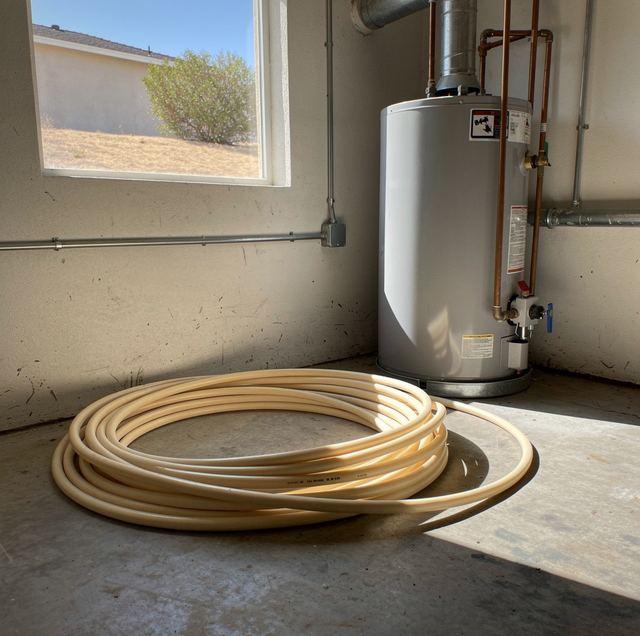
That rating is not hidden. PEX carries a print line repeated along its length, so even a short offcut still shows the manufacturer, the size, the pressure and temperature ratings, the standards the tubing was built and tested to, and its chlorine-resistance rating. If you want to know what is already in your walls, any exposed run at a water heater, under a sink, or in a garage will show you.
One set of marks on that print line gets misread more than any other. Certification for drinking-water contact addresses a different question entirely: it says the material is safe to carry drinking water in. It says nothing about how long that material survives in hot chlorinated water, and reading one as the other is the most common mistake made at a pipe rack.
Disinfection varies by water provider; some use chlorine, while others use chloramine. Your provider publishes an annual water quality report naming which one treats your supply, and it is free to look up.
Two Questions That Separate Rated Pipe From Unrated Pipe
Not all PEX on a shelf is the same pipe, and the difference is invisible from across a room.
What does the print line say, in full? Read past the brand and the size. Look for the standards the tubing was made to, its pressure ratings at stated temperatures, and a chlorine-resistance rating that covers hot water service rather than cold only. A thin or vague print line, or a rating that stops at cold-water use, is not what you want carrying a recirculation loop through an attic.
What does the manufacturer stand behind, and for how much of the system? Makers of quality PEX commonly publish warranties measured in decades, and the better ones cover tubing and fittings together as an installed system rather than tubing alone. A system warranty means the maker tested those fittings with that tubing, and it usually carries conditions about how the work was done, which is a fair signal that installation is part of the outcome.
What Installation Quality Actually Contributes
Chemistry sets the ceiling. Workmanship decides whether you get near it.
Support and spacing: PEX is flexible, which is most of its appeal, and unsupported runs sag between framing members. A sagging line rubs where it crosses a stud or joist, wearing from the outside while the water works on the inside. Correct hanger spacing and protection plates where tubing passes through framing remove that entirely.
Protection from sunlight before the walls close: The stabilizer package that defends against chlorine is the same package ultraviolet light attacks. Tubing stacked in the sun on a jobsite, or a rough-in left open to daylight for weeks, arrives at day one with part of its reserve already spent. Manufacturers publish limits on sun exposure for exactly this reason, and if a repipe stalls mid-project, the exposed tubing gets covered rather than left sitting in daylight.
The right fitting method, done to the tool: PEX connections are made by expansion, by copper crimp ring, or by stainless clamp, depending on the system, and each has its own tool and its own go/no-go gauge for checking a finished joint. Mixing fittings from one system with tubing meant for another, or crimping with a tool that has drifted out of calibration, produces joints that pass a pressure test on the day but fail years later.
PEX or Copper, Which Would Last Longer?
No supply material lasts forever, and anyone claiming otherwise about their own product is selling. PEX ages by oxidation at a rate determined by heat, pressure, and the continuity of system operation. Copper carrying the same water has its own failure mode with its own set of conditions that shorten it. Neither answer is universal: in a given house it depends on that water, how hot the hot side runs, and how carefully each material was installed. Both, correctly specified and correctly installed, are measured in decades rather than years.
How Long Does a PEX Repipe Last?
Manufacturers commonly publish warranties measured in decades, which tells you what they will stand behind, and that is a better anchor than any single number floating around online.
A repipe does not really have one lifespan, though. It has as many as it has runs, and the system's real life is set by its least favorable spot: the hottest, most continuously loaded, least protected run in the house. An uninsulated hot line crossing an attic on a recirculation loop does more aging in a year than a cold branch in a conditioned wall does in five.
Which is why the things that shorten a repipe are so consistent, and so avoidable. Unrated or thinly rated tubing. Sun exposure before close-in. Fittings from a mismatched system, or a crimp tool nobody checked. Long unsupported runs rubbing on framing. Uninsulated hot runs overhead. A recirculation pump left running with no control. None of those are chemistry problems. They are decisions, made once, on the day the work is done.
Every one of those decisions goes behind the drywall with the pipe on the day it is made. From there, the system spends the next several decades drawing down a reserve it was handed once, at a pace nobody can adjust afterward without reopening the same walls. Which is why the print line, the routing, the pump control, and the tool calibration are worth a conversation before the work starts rather than a diagnosis long after it.
Frequently Asked Questions
Only one is relevant. A carbon filter at the point of entry reduces free chlorine before the water reaches the distribution piping, so the downstream tubing experiences a lower oxidant load. A softener does not: ion exchange swaps calcium and magnesium for sodium, leaving the disinfectant untouched. Carbon media also has to be replaced on schedule, since exhausted carbon stops removing anything.
Not the same one. Brass fittings age by different routes, most notably dezincification, where zinc leaches out of certain brass alloys in aggressive water, leaving a weak, porous fitting behind. Low-lead brass alloys formulated to resist that are common in quality systems, and poly fittings sidestep brass entirely. Copper crimp rings and stainless clamps also behave differently in damp locations, which is another reason to insist on system-matched components.
The signs are limited, which is part of the difficulty. On an exposed run, tubing that has aged hard tends to look discolored and to feel stiffer than fresh tubing held against it, which is why a plumber will sometimes cut a short sample and compare the two in hand. Weeping at a fitting under normal pressure, with no impact and no freeze to explain it, is the other early sign worth chasing. Neither is proof on its own, and neither shows up in a pressure test the system passes.
Yes, and the answer is control, not a different pipe. Loops are commonly run on a timer that limits the pump to the hours when a household actually wants instant hot water, on-demand control that starts the pump only when a button or sensor calls for it, or on an aquastat that stops the pump once the loop is up to temperature. If your house has a loop, ask your plumber which of those is on it, because a pump wired to run continuously is the harshest setting the system offers.
Less, but not zero, and the two variables split apart here. The chemical side slows sharply, because standing water carries a finite amount of oxidizer and nothing renews it until a tap opens. Heat does not pause. If a house is going to sit for months, the useful step is to close the main and drain the system, which takes hoop stress off the tubing wall for the entire vacancy and leaves only the temperature working. Refilling is then the moment to run every fixture until the water that sat in the lines is gone.
It sets the baseline temperature the entire hot side operates at, so raising a thermostat to squeeze more usable hot water out of a tank also raises the temperature of every hot run. Where a tank is set to store hotter water, a thermostatic mixing valve at the heater is what blends it back down before it enters the distribution piping, so the tubing spends its life cooler than the tank does. Ask your plumber whether your heater has one and what it is set to.
Water stored hot enough to fill the tank can scald at the tap in seconds, and small children and older adults are burned most quickly. A mixing valve blending it down before distribution is what makes it safe to store it that hot.
Have your existing pipe and repipe options assessed by a licensed plumber — print line read, routing reviewed, no upsell. Ser Plumbing installs recirculation pumps across the area, from hot water recirculation in Lakewood to Downey. Call (310) 953-3566.
