
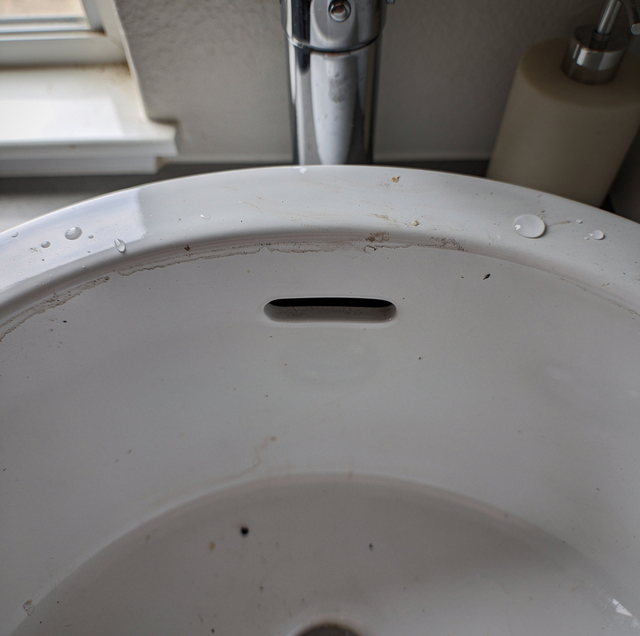
Look at the rim of your bathroom sink, and you will find a slot or a pair of small oval openings, usually near the back, sometimes disguised as a decorative overflow plate. That opening is not decorative. Behind it, cast right into the porcelain or molded into the basin itself, is a curved, hollow passage that runs down inside the sink wall and rejoins the drain body below the basin floor. You cannot see this passage, you cannot reach it with a rag, and unless a plumber has opened it up in front of you, you have probably never known its actual shape. It is one continuous cavity, open at the rim slot and open again where it ties into the drain body just above the tailpiece, and it has been carrying water every time you have used that sink for as long as you have owned the house.
What the Overflow Channel Is and What It Is For
The overflow exists to do two jobs, both of which are about safety rather than convenience. First, it gives a filling basin a second air path. Without it, a fast-filling sink with the drain closed would trap air in the basin, and the water would glug and hesitate instead of draining evenly once the stopper opens. Second, if the pop-up stopper is closed and a tap is left running, the overflow gives the water somewhere to go besides the countertop and floor, carrying it into the drain body before the rim is topped. It is a backup route, built into the fixture, that most homeowners never notice until it starts to smell.
Not every basin has one. If your sink has no rim slot at all, there is no hidden channel to clean or worry about.
Why Water Reaches It Even When the Basin Never Fills
You do not need to fill the basin to the rim for the overflow to see water. The rim slot sits low enough on most basins that ordinary splash and rinse water, the kind that happens every time you wash your hands, brush your teeth, or rinse a razor, runs across the rim and into that opening. It happens gradually and invisibly, a few drops at a time, but on a schedule measured by daily use, not by occasional overflow events. That is the detail most people miss: the channel is not a rarely used safety feature that sits idle between emergencies. It is a low-traffic drain in its own right, wetted constantly by water that never touches the main basin drain at all.
Why the Channel Never Fully Dries
Once water is inside the overflow passage, almost nothing moves it back out. The channel has no fixture pulling suction through it and no flow rate strong enough to flush its own walls; it simply drains by gravity into the drain body at whatever pace the geometry allows. Some basins are molded with a small weep hole at the low point of the channel specifically so it does not hold standing water between uses, but plenty of basins, especially older ones, were not built with that detail, and the channel keeps a film of moisture long after the sink itself looks bone dry. A passage that is damp days after the last time you touched the faucet is a passage that never gets the chance to dry out the way the rest of the fixture does.
Constant dampness, almost no flow: That combination is the whole story of why this one part of the sink behaves differently from everything around it.
What Grows on That Wall and Why It Smells
Splash water does not arrive plain. It carries soap scum, toothpaste residue, skin oils, and stray hairs, and all of it settles on the overflow's interior wall the same way it would on any surface that stays wet and is never wiped. With no scrubbing and almost no current to disturb it, that residue supports a biofilm, a thin living layer that forms wherever organic matter and standing moisture sit together undisturbed for long stretches. As the film breaks down the material trapped in it, it gives off a musty, mildew-like odor that owners usually describe as coming "from somewhere in the sink" without being able to pinpoint it. It is not sewage, and it is not a gas leak. It is a coating, built up one splash at a time, on a wall nobody has ever had a reason to touch.
Many owners also notice the smell is faint when the sink sits idle and stronger the moment water starts running. The channel holds a column of air between uses, and that air carries whatever the film below has been releasing. Water entering the basin displaces that trapped air back out through the rim slot, pushing a concentrated dose of it into the room right as you lean over the sink.
Aim a flashlight straight into the rim slot with the room otherwise dark. A dark, matte film on the visible curve of the channel wall, rather than clean white porcelain, confirms buildup without any disassembly.
The Pop-Up Assembly, the Pivot Rod, and the Hair That Collects There
The overflow channel does not end in open space; it rejoins the drain body right where the pop-up stopper assembly sits, and that junction is its own trouble spot. Hair and soap scum collect on the pivot rod that carries the stopper, which passes through the drain body at this point, and around the base of the pop-up itself, because that is exactly where drain water, overflow water, and the stopper mechanism all meet in one confined space. A basin that smells worse right at the drain opening, rather than faintly from the rim slot, often indicates the buildup is concentrated at this junction rather than spread along the channel.
What Actually Cleans a Channel Nobody Can Reach
This is where most home remedies fall short. Bleach or a foaming cleaner poured down the rim slot runs straight through the channel on its way to the drain body; it barely coats the walls it is meant to treat, and it does nothing at all to the mass collected around the pop-up and pivot rod, which sits below where a rim-poured liquid ever reaches with any force. A real cleaning has to work the whole cavity, not just rinse through it. A plumber's approach starts by pulling the pop-up assembly at the pivot nut, freeing the stopper and clearing any buildup in the drain body. With that assembly out, the channel can be flushed directly from the rim opening, and a flexible brush or a length of stiff line fed in from that same opening physically scrubs the far wall in a way that gravity flow alone never does.
When the Smell Is Not the Overflow at All
Not every bathroom sink odor traces back to this channel. A dried-out trap losing its water seal produces a very similar rotten smell, and no amount of work inside the overflow channel will touch it. If the odor persists after the channel and pop-up have been cleared, the trap and the fixture's connection to the rest of the drain system are the next place to look, not a second attempt at the same passage.
Frequently Asked Questions
Most drop-in and undermount basins do, since the bowl mold casts the channel in by default, and a pedestal basin keeps it for the same reason. A basin with two small oval openings at the rim rather than one long slot still has a single channel behind it; the twin openings are a trim choice, not two separate passages. Not every basin has one, so the rim is worth checking before assuming there is a channel to clean.
You can look, but not much more. A basin brush or bottle brush usually cannot bend around the internal curve, and a squeeze-bulb or turkey-baster-style tool pushed into the rim slot can force a little water past the bend, which helps you gauge whether it drains freely, but it will not scrub a coated wall the way a plumber's brush fed in after the pop-up is pulled will.
No. The two are distinguished by how they respond to running water, a different test from the one that identifies a dry trap. An overflow-channel odor peaks in the first second or two of flow, then thins out while the tap keeps running, because the channel has only one pocket of standing air to push out, with nothing refilling it until the sink goes quiet again. A trap problem behaves the opposite way.
No. The channel rejoins the drain body above the trap, so pulling the pop-up assembly and flushing the channel does not disturb the trap or its water seal at all. The two repairs are independent of each other.
No. Many basins fit a decorative trim plate or cap over the overflow opening, held by a screw or a simple snap fit, mainly to keep the slot from looking like a raw hole in the porcelain. Removing it lets you look a short way into the top of the channel, but it does not expose the full passage down to the drain body, so it is not a substitute for having the assembly pulled.
A soft whistle or hum from the rim opening when the tap runs at full flow can mean the channel's air path is partly restricted rather than fully open, since a narrowed passage makes displaced air move faster and louder through the room that remains. It is worth mentioning if you also notice a slow-draining basin or a persistent gurgle.
Odor that returns after every cleaning usually means the channel and pop-up need direct attention — a professional flush and inspection will clear both without guesswork. Ser Plumbing clears drains across the area, from drain cleaning in Bellflower to Lakewood. Call (310) 953-3566.
