
Quick Answer: A vanity replacement splits into two jobs: the cabinet and top, which the supplier or installer sets, and the plumbing, which covers the angle stops, supply lines, drain, pop-up assembly, and trap alignment underneath.
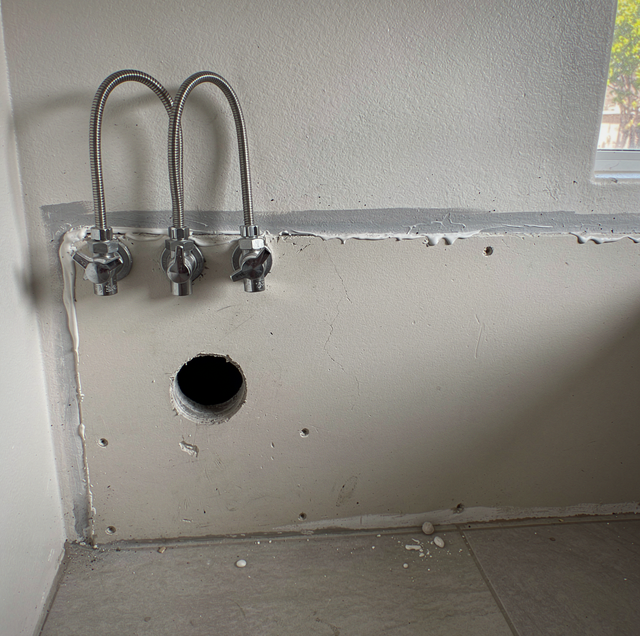
The old vanity comes off the wall, and the bathroom looks unfinished in a way it never has before. Two shutoff valves sit at knee height with a pair of supply lines running up off them. A drain opening sits lower and usually off to one side. Paint stops where the cabinet used to start.
That is the moment a vanity replacement stops behaving like one project and shows itself as two. One job is the cabinet and the top: the box that sits on the floor, the surface that lands on it, the basin set into or built onto that surface. The other job is everything that carries water to and from those pieces. They are different trades; they happen in the same small room, and the order in which they meet is what decides whether the bathroom is usable that evening or sitting open with the water off.
Where the Cabinet Work Ends and the Plumbing Starts
A plumbing company does not build or hang cabinets, fabricate or supply countertops, or run the room as a general contractor. The vanity box, the top, the wall behind it, and the floor under it belong to whoever supplies and sets the vanity: a showroom crew, a cabinet installer, or the contractor running the bathroom.
The plumbing side starts at the wall and ends at the fixture. That covers the angle stops and the supply lines feeding the faucet, the faucet itself, the drain assembly in the basin, the tailpiece below it, and the trap that ties the basin back to the drain opening in the wall.
There is a physical reason the split falls exactly there. None of the connections can be made until the cabinet is level and the top is on it, because the positions of the basin outlet and the faucet are both determined by those two pieces. A cabinet that is not yet level still moves when it is shimmed, and a trap connected before that happens comes under strain. So the plumbing waits on someone else's work.
Pulling the Vanity Exposes the Oldest Hardware in the Room
The valves behind a vanity are among the least disturbed plumbing in the house. They were set when the house was built or when the bathroom was last redone; they were hidden behind a cabinet back panel, and nobody has turned them since. In hard-water areas, they sit in that position while minerals work on everything they touch.
They matter now because the new faucet lands on them. A faucet installation includes new supply lines, and those lines have to make a clean connection at the valve. The stops get looked at while they are open to view, which is the one time they are easy to reach.
Locate the main shutoff before anything under the vanity is disconnected. An old stop that has not moved in years can fail to close, and a supply line pulled off a valve still passing water floods the cabinet.
If a stop will not hold, the water for that fixture is controlled further upstream until the valve is addressed, and the rest of the vanity work waits on it.
The Drain and Pop-Up Assembly Come Out Together
The drain in a bathroom basin is not a single part. A flange sits in the bottom of the bowl. The drain body passes down through the hole in the basin and is drawn up tight from underneath against a seal, so the joint between the bowl and the body is squeezed rather than glued. A tailpiece hangs off the bottom of that body and drops toward the trap. Behind the faucet, a lift rod runs down through the deck and connects to a clevis strap clamped to a horizontal rod that enters the side of the drain body. That rod is what raises and lowers the stopper.
Because those pieces are clamped and sealed to one specific bowl, the assembly comes out with the old basin and does not go back into the new one. The seal has taken a set against the old porcelain. The body is cut to a length that suited the old bowl depth and the old top thickness. A new basin gets a new assembly, adjusted to the new bowl.
Getting the linkage right is the fussy part of the job. The clevis strap has to be clamped at the height where a full pull on the lift rod seats the stopper and a full push opens it, with the rod itself sitting square behind the spout. Set it wrong and the stopper either never closes or never sits flush.
The New Basin Outlet Has to Meet the Existing Trap
The trap has one job in this context: to physically connect the tailpiece hanging under the basin to the drain opening in the wall. Both ends are now in different places than they were.
Vanity cabinets are not all built to the same height, basins are not all the same depth, and tops are not all the same thickness. Stack a taller cabinet, a thicker top, and a deeper bowl, and the basin outlet ends up lower than the old one. Stack the opposite, and it ends up higher. The bowl may also sit farther to the left or right than the old one did, which changes the horizontal distance the trap arm must cover before it reaches the wall.
The trap has some adjustments built in. The tailpiece can be cut down. The trap arm slides in and out of its wall connection within a range. The trap can be rotated. Past that range, the parts themselves change: a different tailpiece length, an extension, or a trap of different proportions. Whether the alignment falls inside that adjustment is not knowable from a catalog photo, which is why the trap is fitted after the basin is in place.
Past the point where parts solve it, the opening in the wall itself is what has to move. That is pipework behind the wall surface rather than fixture work inside the cabinet, and it is a different conversation from swapping a tailpiece. The same applies on the supply side if the new cabinet puts the valves somewhere a supply line cannot reach cleanly.
The Top Arrives Already Drilled, and the Faucet Has to Match
A vanity top shows up with its faucet holes already cut, and the number and spacing of those holes were decided when the top was bought. A single-hole faucet needs one opening. A faucet built with separate handles needs the pattern the top was drilled for, and it needs the handles to reach.
Nothing about that is adjustable on the plumbing side. Cutting or drilling a finished top is fabrication work, and fabrication is not plumbing. If the faucet in the box does not match the holes in the top, one of the two is going back, and the vanity sits unusable in the meantime.
So the pairing is a purchasing decision made before anyone arrives with tools. If the faucet is bought separately from the top, the hole count and spacing are what to check first, ahead of finish or brand.
Sealing at the Deck Is the Last Plumbing Step
Two places on the deck let water pass if they are not sealed. The first is where the faucet body meets the top, handled by the gasket or base plate that came with the faucet, held down by the mounting nuts underneath. The second is the flange in the bottom of the bowl, which is sealed against the basin when the drain body is tightened from below.
What matters is where that water goes when a seal is skipped. Water standing on a deck does not sit still. It finds the gap at the base of the faucet, runs down the outside of the shank, and drips into the cabinet, where the first sign is a floor panel that swells and darkens weeks later. The same is true of a flange that was not seated properly: the leak shows up under the cabinet, not in the bowl, so nothing looks wrong from above.
The joint where the top meets the wall or the backsplash is a finish seam and belongs to whoever set the top. The fixture penetrations through the deck are the plumbing side of that same surface.
Order Decides Whether the Project Stalls
The sequence is short, but skipping a step in it strands a bathroom mid-project. The water comes off, and the old faucet and trap are disconnected. The old vanity comes out, which is cabinet work. Any wall or floor work happens while the space is open. The new cabinet is set and leveled, the top goes on, and only then can the faucet, the drain assembly, the supply lines, and the trap be fitted.
Have the faucet and drain assembly on site before the top is set. Both are easier to fit, and the underside of the top is accessible from every direction rather than from inside a finished cabinet.
The access conditions under an existing sink are a subject in their own right. What a single plumbing visit covers from arrival to test is likewise its own topic. The point that matters for a vanity is narrower: the plumbing cannot start until the cabinet trade is finished, and the cabinet trade cannot finish until the old plumbing is disconnected. Two handoffs, in that order.
Frequently Asked Questions
It changes what can be adjusted. On a one-piece top, where the bowl and deck are formed as a single unit, the outlet position is fixed by the molding and cannot be shifted. With a separate basin dropped into a cutout, there is some choice in where the bowl sits front-to-back within that cutout, which gives a small amount of room to work with when the drain has to meet the wall opening.
The openings in the wall stay exactly where they are. A narrower or shallower cabinet can leave the supply valves and the drain opening outside the new footprint, exposed beside or behind the vanity rather than hidden inside it. The connections can still be made at those same openings, but the wall surface around them is a finish question for whoever is running the room, not a plumbing repair.
Yes. A basin with an overflow channel needs a drain body with openings through its side wall so that channel has somewhere to discharge. A basin without an overflow takes a solid body with no side openings. Fitting the two the wrong way around either seals off the overflow so it cannot do anything, or opens a path for water to escape the drain body into the cabinet.
The handles and the spout are separate bodies rather than one casting. Each one is secured through its own hole in the top, and they are joined underneath the deck by connecting tubes that carry hot and cold across to the spout. Three pieces have to be held square and in line while everything is tightened from below, and the spacing of the drilled holes has to match the reach of those connecting pieces.
Not automatically. A second basin needs its own hot and cold supply connections and its own drain connection, and none of that exists in the wall behind a cabinet that was built for one bowl. Whether they can be run and where they would come from are determined by what is actually in that wall, not by the vanity dimensions.
A vanity cabinet that ships with a solid back needs openings cut for the valves and the drain, and that cutting happens where the cabinet is set. That work belongs to whoever installs the cabinet, not to the plumbing side. What the plumbing side can hand over beforehand is the measured position of each stop and the drain opening, taken off the wall while the old vanity is out, so the cutouts are marked from the existing wall rather than from the vanity's spec sheet.
Line up the plumbing side before the new vanity arrives — so the stops, drain, and trap are handled the day the cabinet goes in. Ser Plumbing hydro jets lines across the area, from hydrojetting in Downey to Bellflower. Call (310) 953-3566.
